About The Authors

Thursday, September 15, 2016

4% Growth?! – Trump channels Bush's 2015 pipe dream

mike smitka

Just a quick cross-reference to a February 2015 post on this topic, "Promises versus Deliverables: Jeb Bush and 4% Growth". The argument that 4% growth is unrealistic is even stronger than it was 18 months ago, as labor market slack is less. We do not have 25 million Americans just waiting for a job to be created. Here is the latest update with data through the September 2016 employment data release of my periodic projection of actual vs "normal" employment levels, where the latter is adjusted to reflect the slowdown in population growth including the retirement of the "boomers."

Wednesday, September 14, 2016

A Puzzle: long-term interest rates

mike smitka

I'm hesitant to post this graph: rates are volatile and I know that looking for trends in financial markets is silly. OK, provisos out of the way. But I've faced a puzzle for the past several years in the flatness of the yield curve. Comparing the difference in rates at various maturities, say between 7 year bonds and 10 year bonds, allows us to calculate the implicit return investors expect to have on a 3-year bond in 2023, some 7 years hence. I normalize all those into equivalent one-year bond rates. Here, that means the rate that you need for back-to-back purchases of three 1-year bonds to make the total return of a 7-year bond and three 1-year bonds equal to that of a 10-year bond.

Friday, September 9, 2016

Evolution or Revolution? Yes, and Margin Squeeze

mike smitka

When it comes to claims of technology revolutions, I'm reminded of The Who's song:

There's nothing in the streets / Looks any different to me ...
Don't get fooled again!
Meet the new boss / Same as the old boss ...

Friday, August 19, 2016

Durable Goods and Used Car Prices

cargraph

Elizabeth Platt, May 2016. Reposted from the Econ 244 site.

As discussed in class, an automobile value depreciates as soon as it’s driven off the lot. A recent study using iSeeCars.com puts a number to that depreciation. Analyzing 15.7 million cars over the course of the year, the study finds the average car value loss is 17% of its value in the first year. However, individual models differ in their value loss. At the top of the spectrum, the Hyundai Genesis loses 38.2% of its value in the first year.

The study cites demand as a function of reliability, popularity compared to competitors, dependability, repair costs, and redesigns. Thus, many of the factors the study believes determine demand cannot be estimated until at the time of the purchase, making resale value more difficult to gage. The drop in value after the first year corresponds to a potential savings of $16,000 if the consumer purchases a slightly used model. Consumers have the option of buying a new car with little knowledge of its reliability or waiting a year to purchase a slightly used car with more information in one hand and savings in the other. One significant part of demand, though, is aesthetics. By waiting for a slightly used car, the consumer runs the risk the manufacturer may introduce a newer model. In a society centered on “keeping up with the Jones,” newer models make the option of a slightly used model unappealing to some consumers. On the other hand, not all cars depreciate at this magnitude, making a slightly used model less of a deal. The study found some models lose less than 10%, such as the Subaru Impreza which lost just 3% of its value in the first year. In the end, knowledge concerning the difference in value of a new and a used car can be extremely beneficial for the consumer.

UsedCarsSource: https://www.washingtonpost.com/news/get-there/wp/2015/01/21/the-best-bargains-for-buyers-looking-for-lightly-owned-used-cars/

...there is no such thing as a new car...

Chart by the Prof using data from the auto auction firm Adesa. These data are raw averages of varying mixes of vehicles. Tom Kontos, their chief economist, analyzes this in much greater detail, by brand, like-vehicles, with seasonal corrections and on and on.


The Prof's comments: This is a neat topic, because the physical depreciation of a car is different from the economic depreciation. It is also at least in part a strategic variable that car companies can influence, through adjusting competition among vehicles in their model lineup and the timing of new model introductions and (as noted below by Michael Adams) fleet sale and leasing policies.
The overall declining trend is a reflection of the Great Recession: no leasing and few sales of new cars and lower incomes led to a dearth of used vehicles amidst greater demand for generally less-expensive used vehicles. That effect lingers but has largely worked its way through the system. You can though see changes by category, e.g. trucks vs smaller cars. I don't know the impact of interest rates on the "yield curve" of cars. Lower rates make both bought-new and bought-used cars less expensive, at least for purchasers who are thoughtful about their financing options. Companies such as ALG that are involved in leasing surely model that. My hunch is that the income effect – higher purchasing power – offsets the substitution effect so that there is no net impact.

Comment by Michael Adams: This article helps to explain why firms, notably General Motors, have begun to scale back on fleet vehicles. The slightly used fleet vehicles, depreciated during their time of service, are quickly resold as used cars and compete with brand new models. Consumers can reap the benefits of a purchasing a gently used car if they are willing to wait for even a few months.

Murray Manley commented: I think this article is particularly interesting because it highlights the difference in some examples of consumer and producer preferences. For example, producers are always working on producing the next model and aiming to engineer the best car that matches or exceeds the car of competitors. This “keeping up with the Jones’s” in the producer and manufacturing world leads to increased profits- whoever can produce the best vehicle the fastest will ideally sell the most cars. On the other hand, while some consumers prefer to always have a new and fashionable model of a car, others cannot afford, don’t care about, or are unaware of style changes from year to year. In that respect, the customers who care less about new models benefit because slightly used cars will always be significantly cheaper if producers continue to come out with new models quickly.

Tuesday, August 16, 2016

Visit to Fox Recycling

Prof Mike Smitka

composite of student blog posts

In May 2016 I led students to Detroit, where we visited a wide array of auto-related businesses, as well as seeing something of the city and talking to residents (Tyree Guyton of the Heidelberg Project) and Martin Lavelle of the Detroit Branch of the Federal Reserve Bank of Chicago. This is the first of several posts that will convey student observations made in their online journals and blog posts. All the underlying material can be found at the W&L WordPress site for Economics 244. I've cut-and-pasted pieces, with prose to smooth the flow, but tried to maintain the voices of my students so am deliberately leaving it a bit choppy.

This post combines material from Barrett Snyder, Michael Adams, Elizabeth Platt, David Hochstadt, plus snippets and photos from others. Due to cutting and pasting, I've not attributed everything. Particular thanks are due Barrett Snyder, who set up our visit.

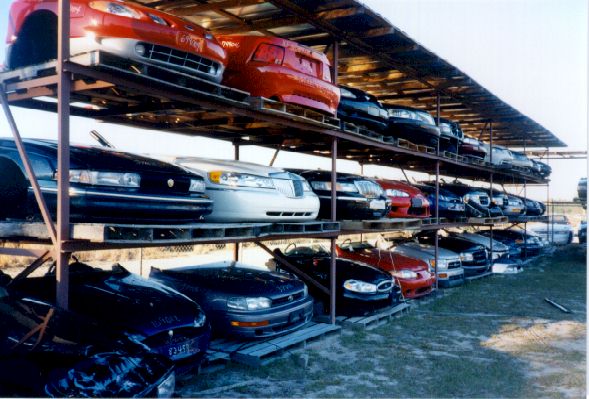
Class began the morning of Thursday, May 12th by traveling from our base at the Best Western Greenfield to Belleville, Michigan, about halfway to Ann Arbor. There we visited Fox Auto Parts, which has been in business since 1973. Here we met with Bill Fox, one of two brothers, who own both an automotive recycling facility and a self service “pick and pull” style yard. Mr. Fox explained to us the process of purchasing totaled vehicles from two main auction companies, Insurance Auto Auctions and Copart, and how cars are dismantled and parts are sold to body and mechanics shops. Mr. Fox stressed the importance of purchasing the correct number of vehicles and of the correct type in order to turn a profit in a business model with such slim margins and high overhead. Auctioned vehicles run between $1,000 and $10,000, depending on the model and the condition; the average acquisition price is about $1,800. Each day Mr. Fox checks out insurance auctions online and bids on several different cars electronically. If a vehicle is not from the 40+ acre IAA facility that is located adjacent to their property, then then have to pay shipping costs as well. The focus is on relatively new vehicles; the average car is less than 10 years old. After that demand falls off, both because there are fewer vehicles left on the road, and because fewer people are willing to pay the cost of installing a "new" engine in a car that age.

Elizabeth Platt added notes on the process. The first stop was where the cars are brought in and the major parts are removed to be sold. While software helps Mr. Fox estimate of what the car is worth, until they actually get the vehicle they cannot know exactly which parts are salvageable. We watched them go through some of that process, as they inventoried a newly arrived vehicle for what sections of it seemed to have no damage – which lights appeared good and so on. They we visited the area where a power train was being dissembled and checked for leaks and other signs that it might not be good. There was also a bay where everything had been stripped all the way down to the frame of a F-150. Anyway, each pulled part is categorized with a tag to be easily accessible to be sold in the future. But once they've assessed the extent of the damage to the car and categorize all the parts from the car which they can sell, they then leave most of them on and use a forklift to put it in their yard. Then if they get an inquiry, their computer will let them know if they have a car where that part is undamaged out in their yard. That's a lot easier than pulling, categorizing and storing parts that might never sell.

The software used to purchase vehicles is called “Bid Buddy” and helps to generate a maximum bid for a vehicle by using a formula that accounts for part sales, activity, and current inventory. We also discussed the cooperation between independently owned salvage facilities. The greatest example of this was the PRP trailer system that runs across a good portion of the nation, used to transport brokered parts between recycling facilities to fulfill each others needs and help say “yes” to the customer more and more often. The network is run jointly by 80-odd recyclers, ranging from the Snyder family business in Texas at the southern extreme, through the midwest and into the northeast. Depending on locus a recycler gets a truck twice a day that can transport a body panel from Texas (no salt on the roads so no rust!) to Fox to sell to one of their customers. Fox in turn has a copious supply of Fords, including F-150s, and they may be sending a transmission from Michigan to Texas.

Sam Wilson noted that this cooperation was not just at the institutional level but also at the individual level. Not only did the owner of this yard know the father of Barrett Snyder, a member of our class whose family has owned and operated its own Auto parts yard for a long time in Texas. Barrett’s father had actually helped this owner expand into a secondary line of revenue, a You-Pull-It yard. The YPI yard was set up with many rows of cars by the same manufacturer and individuals could pay two dollars to enter the lot, search the cars and pull off/out whatever pieces that they needed. They paid a discounted price at the end for whatever they wanted to take home. From what Barrett explained, this is really becoming the larger end of the market down in Texas. This market is mainly made up of individuals who have some auto background and either: 1) are rebuilding for fun and need specific pieces for as a weekend hobby, or 2) their car broke down and rather than spend lots of money to take it to a repair shop will come to the yard and get the piece they need to be able to get to work on Monday.

They also have to judge how long to keep a car in inventory, as it uses both working capital and physical space – they keep their lot, which holds a bit over 900 vehicles, relatively full. We were all impressed that despite the outward appearance of the business as dirty and labor-extensive, it relies on a lot of technology. In addition to using a packaged computer program to assess the value of a car before bidding, Fox uses algorithms to track how often customers request certain parts based on inquiries and customer feedback; their sales staff do a lot more than just answer the phone. This information allows Fox to be sure to have high demand parts in stock at all times. The owner stressed to us during our visit that Fox is not competing directly with other salvage yards but is instead competing against auto parts stores such as Advance and NAPA, and even the OEMs. (For example, OEConnection uses their database of repair parts as the foundation for software systems that they sell to OEMs such as Ford, to help their dealers sell parts to independent repair shops including the in-house ones run by cities and other "fleet" operators.) Anyway, these national chains of parts shops and new car dealerships are the big players, along with a few large, publicly traded companies like LKQ that Fox and Snyder fee offer you poor service and a poor product because they lack the family touch.

Henry Schwartz noted that the cars are placed outside for an average of six months during which time Fox sells every part off the car that they possibly can. They can pull wires (copper), catalytic converters and other items of value. The car will be crushed and sold for scrap steel. (The don't have a shredder – for that stage of the recycling process see this blog post on the Prof's visit to one in Japan.) After six months Fox will only scrap a car after they have broken even on it by selling parts to customers. As Mr. Fox pointed out, more that 80% of the overall vehicle that comes into a facility is recycled, making it the “greenest” portion of the auto industry. Many people don’t realize that the shops that do insurance repairs for the public often use recycled parts. After receiving their vehicle back, most would assume that the parts used were brand new. All the while, that fender or windshield wiper motor that was installed is now living its life again in a vehicle instead of residing in a land-fill.

Platt was fascinated by the YPI yard. That business model illustrates how a company can make profit on items that would otherwise be discarded. By cutting out the cost of labor, the part can be sold for less and also attracts consumers seem to truly enjoy the process of finding parts and fixing their own cars. What however are the legal liabilities of this process? The customer must sign a release form and pay an admission fee, and bring their own tools, but the potential for accidents is still there. The owner did not go into detail about this. Nate Frank, another student, wondered if the ROI wasn't a lot higher in the YPI yard, as the 900+ cars in their main yard (plus the warehouse and so on) represents $8-$10 million.

David Hochstadt noted that there has been a decline in mid-sized salvage companies, many of which have been bought by larger, publicly traded companies. The smaller, family operated firms are left to fend for themselves and face the dilemma of either expanding or risking going under. Fox currently purchases around 100 cars per month whereas a firm like Barrett’s family will buy closer to 200 per month. The business is very fixed cost driven, building structures around items and engaging in capex intensive purchases like construction equipment and warehouse space, in order to move things around and store parts. In order to continue operating an expand, Fox needs to make shrewd decisions in terms of the price they pay at auctions as this will increase their margins and allow them to hire more employees, purchase more vehicles and expand their operations. It was amazing to see how much of a car can be reused even after it has been in a wreck and deemed totaled by insurance companies: everything from transmissions and engines to things like wire harnesses (as they have the highest concentration of copper in a car) and steering columns. He asked about the future of the car industry and how it would affect salvage companies as the average model year has been getting younger. Will they be able to salvage things like rear-camera systems, safety-critical parts where they would find it hard to judge whether they are truly without damage? In the next couple decades, won't the biggest threat to salvage companies be the shift to autonomous cars, as this would lower the number of accidents, hurting both how they obtain cars – supply – and demand for parts?

Friday, August 5, 2016

Tesla Note: Dealerships and Inventories

Mike Smitka

One point in my critique of Tesla's flawed business strategy is that by engaging in direct sales it uses up precious cash. First, it does continue to burn through cash, though at a slower pace: cash from operations plus financing in 2016 Q2 came to -$160 million, up from -$480 million in Q1. However, this includes $150 million in deposits for Model 3, so on a recurring basis they went through -$310 million. This was offset by $2 billion in new money, but I would expect financial markets to prove reluctant to keep providing new money at this pace. So Tesla needs to conserve on cash. Yes, they receive cash from leasing, $143 million in the past quarter. This is normal for the industry, particularly for high-end vehicles. However they and not their banks likely bear the residual risk. So this could prove to be very expensive cash if lease-end resale prices are less than those built into the leases. Such unpleasant surprises are far from unknown in the industry. Oh, and Tesla has also run through their subsidies from the State of California, in the form of ZEV credits: last quarter they were $57 million, but this quarter they were negligible. They won't be able to count on this cash and the fat per-vehicle margin it has provided as they move towards the Model 3.

So how can they improve their cash position? In two words: franchised dealerships. Ford Motor Co. had Q1 revenue of $36.9 billion and inventories of $9.8 billion, or 27%. Averaged across a few quarters gives a level of 25%. How about Tesla, with their direct sales model? They have inventory of $1.6 billion on revenue of $1.3 billion, or 125% – 5x the level of Ford.

Can Tesla afford to expand their direct sales network? My answer remains no.

Tesla violates two prime rules of new ventures: preserve cash and preserve management time

To be fair, there is a devil's advocate position. The land and structures of a dealership hold value, where used by Tesla or someone else. In particular, Tesla could lease its stores from existing car dealerships, with the added benefit that they might be able to avoid creating stand-alone service bays. Banks could also provide floorplan, industry jargon for the financing of dealership inventory. These would lessen the drain on cash – but on net they would not generate cash. Back of the envelope calculations – very round numbers – suggest that the cost of a national dealer network would run $5 billion. (I've gone back and forth on this with co-blogger David Ruggles and one other invidiual.) Net of financing, this might require $1 billion in additional cash, spread out across multiple quarters. So it is not out of the question. To my knowledge, however, Tesla has not demonstrated any distinct advantages to its direct sales approach, other than PR, at the expense of significant management time and (I suspect) legal and lobbying costs. In fact, on the Pied Piper dealership satisfaction index, which uses mystery shoppers, Tesla ranks dead last.

On the dealership issue Tesla violates two prime rules of new ventures: preserve cash and preserve management time. So I remain a skeptic.

Footnote: Nikkei just reported that Nissan – joint with Renault a larger electric vehicle manufacturer than Tesla – is selling off its battery making operation. Why? Doing it in-house is more expensive and slower in keeping up with new developments. Why should Tesla be an exception? Source: 日産、車向け電池事業撤退 子会社売却へ 2016/8/5 17:34 日本経済新聞 電子版

Saturday, July 30, 2016

Predicting SAAR, Deconstructing SAAR

Mike Smitka

As an economist, I avoid the prediction game. I am also wary of reading much into a single month's data. What an economist can do is to provide reasoning why over time a particular average level of sales makes sense, and levels significantly above/below do not.

Let me start with the monthly time horizon. Next Tuesday we'll get the latest sales numbers this coming Tuesday (August 2, 2016). Those numbers will tell use sales down to the last vehicle, except for Tesla, which reported sales of 2,250 for the past 4 months. That's a false level of precision. First, there's human error, though that ought to average out. A sale won't get reported, or digits will get reversed, or ... The Law of Large Numbers though means that while there will be over- and under-reporting by individual dealerships (and DMVs), those will average out and not cause much error in the total for the whole market. But one thing we know is that claiming there were exactly 1,513,086 light vehicles sold in the US in June 2016 is not true. When I present data, I try to round things off to 3 significant digits, here to 1,510,000 units.

I dutifully look at the numbers, but for the next year or so I really don't expect to learn anything from them

Then's there's the conceptual issue, that what "sold" means is less than clear. Dealers face incentives to tweak the numbers to earn "stair-step" incentives where one more vehicle can add a lot to their bottom line. Better to get the bird that's almost in hand by reporting a sale, than to carry it over to the next month when they might fall well short of (or significantly exceed) the threshold with an uncertain payoff. In Europe, discounting takes an indirect form: rather than placing cash on the dash, as it were, a car will be sold and reappear on the dealer's lot as a used car with zero mileage. They're "sold" and they're not. The data again offer a false sense of precision. Again, my sense is that an error (accidental or deliberate) in one month gets averaged out in subsequent months. But it does mean reading too much into one month is inappropriate.

Then there are the random factors, snow storms and holidays that fall midweek and ... there are such every month. Whatever the "true" level of demand, the performance in any reference period will deviate from that. Yes, we can apply seasonal corrections, and try to remember that February sales in a leap year will of course be higher, and sales in a month with 5 Saturdays may also be quite different. Such corrections however are but fancy averages, and so will never get the adjustment quite right.

So what can an economist say? There are the house economists at Ford and the others, who in conjunction with others in management need to provide a number for each product for the coming month and quarter and year for scheduling overtime and shutdowns at the plant level, for issuing purchase orders to suppliers orders for the next 30 days, and for planning capacity. In this role a house economist is as much soothsayer as professional. Formal models get combined with experience to which hunches are added, because at the end of the day there has to be a number. What will the Fed do? Over the past year, much less than the Federal Open Market Committee members themselves had predicted. But even if they bump short-term interest rates by another 25 basis points, will that affect the rates on car loans at all, or otherwise change sales? There's no reason to think they'll get this right any better than the traders who are betting billions on bonds.

why no mention of GDP: some "advanced estimate" components are good, the headline number not

An economist can however put some limits on what is likely to happen, using theory and a reading of the available data (which only show what happened last month or last quarter, never what is happening today, and absent theory tell us nothing useful about what will happen tomorrow). Here I look at two factors that influence automotive sales, interest rates and employment.

Employment first. Over the long run light vehicle sales correlate very closely with total employment, with about 1 sale for every .12 sales for every million workers, With 145 million people employed, that gives a SAAR of 17.4 million. This is not a tight relationship in the short run, and over the full period of the graph shows a downtrend. Indeed, a simple linear regression would suggest that I use .10, though for technical reasons that surely exaggerates the trend. In any case, that hints that 17.4 million is somewhat generous.

Employment continues to increase. Part of that is because the overall population continues to rise. Using age-specific population projections and the relatively stable rates of labor force participation prior to the Great Recession lets me estimate a normal level of employment, the red curve in the graph below. That's rising at about 58,000 a month in mid-2016, falling to about 50,000 by mid-2017 and 26,000 in 2018. In short, fertility plus immigration is barely offsetting the retirement of the Baby Boomers. On that basis the labor force will increase by only 900,000 workers over the next 2 years. That means we won't see SAAR rise by more than 100,000 units, which is smaller than the month-to-month volatility in the sales data.

But as we know, the US economy has yet to fully recover from our Great Recession. Compared against the demographic-corrected trend level, employment remains about 4.3 million below the pre-recession levels. The US economy has shown steady employment growth for the past 5 years, since summer 2011. We've also seen participation rates increase for prime-age workers, though that too remains below pre-recession levels. Barring a distinct slowdown or a boom – nothing in the real estate and residential construction markets suggests either – then we will keep adding jobs for another 2 years. Using the 0.12 figure, that will push car sales up by 0.5 million units. So if I were an optimistic, I could point to a potential SAAR of 17.5 + 0.1 + 0.5 or 18.1 million units by end-2018. I think the likely sustainable sales rate relative to employment is likely closer to 0.11, while the economy faces more headwinds than tailwinds...

How about interest rates? Here the picture is quite clear: they will stay low. First, the Fed is unlikely to raise rates aggressively, given the lack of signs of either inflation or accelerating growth. Second, across the globe growth are down. The developed world, plus China, are aging. The population of Japan is falling in absolute terms, and the working age population is falling in Europe and in China. Then there's productivity: an economy grows even with a fixed number of workers as long as output per worker grows. While we have new gadgets galore, the increase in productivity from having a smart phone is less than that from having a phone. We in the developed world see some gains, but the realignment of work that access anywhen to the cloud enables is only affects a certain share of jobs, is happening only gradually, and is not leading to large gains in output. That example can be repeated for a variety of technologies; see Robert Gordon's The Rise and Fall of American Growth for a systematic analysis. [The work structure example is my own.]

All of this is reflected in interest rates: they have fallen across all maturities, as reflected in bond prices. Furthermore, the yield curve suggests no upturn in interest rates for the foreseeable future (which for US bonds is 30 years), either due to stronger growth or to inflation (or, more accurately, the sum of the two). That strikes me as an odd bet to make at 20 year time horizon, and historically long-term bonds haven't been good indicators of what will happen. In the 3-5 year time horizon, however, the story told by bonds is more credible: we won't see a boom. I have both a basic interest rate graph, and one that looks at the implied yield on 1-year bonds, calculated for example from the difference in 2- and 3-year bond yields.

The final element is energy prices. My track record is abysmal, but so to my knowledge is that of everyone else. (For my posts on energy, See "Another Fracking Saudi Conspiracy Story" and here for "Peak Oil Revisited: Did I Get Anything Right?") From the perspective of extraction costs, the era of really cheap oil is over. For now, however, fracking offers a lot of potential at intermediate prices, while demand growth has slowed and the cost of alternative energy sources has fallen, including both solar and wind. The world has more natural gas than it can consume, and while over time the ability to transport it from where it is produced to where it might be consumed via pipeline and LNG ships will affect that, it's hard to see what might affect prices of gasoline in the US through 2018.

In conclusion, next week we'll see many column inches and blog posts dissecting the latest sales report. At the firm and maybe even segment level, it could contain information, though at the monthly level I'm still reluctant to play that interpretation game. More generally, we'll have more of the same. I dutifully look at the numbers, but for the next year or so I really don't expect to learn anything from them.

Thanks to Dr. Paul Traub of the Federal Reserve Bank of Chicago, Detroit Branch and former head economist of Chrysler for pointing out the strong correlation between employment and sales. This idea can be tweaked in various ways, setting up a multiple regression framework that would incorporate changing vehicle longevity, putting in a separate variable for those employed but over age 65 and for under 25, putting in a variable for changes in gasoline prices, and for the interest rate (or perhaps, using a combination of loan rates and loan maturities and vehicle prices, monthly payments). Obviously I've not done that.

Tuesday, July 26, 2016

Book Review: Nick Kachman's Paint it red

Mike Smitka

Nicholas Kachman, GM: Paint it Red. Paperback. Buena Vista, VA: Mariner Publishing, 2015.

Businesses fail all the time, indeed a new business is lucky to last 5 years. Few notice such passings. It's more puzzling why big corporations on occasion self-destruct. They command substantial resources and have professional staff to follow market developments, and to handle operational aspects of the business with a level of sophistication and specialization that the handful of individuals in a small firm cannot hope to match. In the case at hand, General Motors helped define not just the auto industry, from market segmentation and the annual model change to consumer finance and the management of styling. They also helped develop modern management, as the exemplar of the multidivisional company with the separation of staff and line and the use of return-on-investment accounting to allocate capital. It's appropriate that the business school at MIT bears the name of Alfred Sloan, the single most important individual in the transformation of the company from a flailing conglomerate to displace Ford after 1921 as the dominant force in transforming the industry. Market research, corporate-wide applied engineering that helped lower costs year after year, a strong dealer system – the company seemed to be all strengths. During the 1960s it was not only the largest manufacturing enterprise in the world, but it systematically earned a double-digit return on sales, returns on investment of over 20% and returns on equity of 40%.

Yet fail GM did, maintaining high levels of investment and an overall lack of panic as they lost 2/3rds of their 1960s market share. Unlike with smaller firms, that's horribly costly not just to investors: many retirees and pension funds were GM-heavy. It was also costly to hundreds of suppliers and customers (for a car company, that means dealerships), to a quarter million or more individuals with family members who worked there, which combined to traumatize whole communities. Unlike a small business, where the owner as manager bears both responsibility and loss, most of those hurt in GM's failure were innocent participants who had no input into the decisions that led to failure, and often little ability to insure themselves against the consequences.

So why did GM decline, year after year, with little apparent concern in the C-suite? Unions weren't responsible for cars not selling and plants sitting idle. Nor were they behind poor financial decisions, from the depletion of cash reserves (the proximate cause of any bankruptcy) to investment projects that failed.

Nick Kachman's book, ably edited by family friend Ethel Burwell Dowling, provides insights into this on two levels. First, it portrays the power plays within the company at the senior management level where accumulating personal power while undermining rivals became central to the fight for promotion. While he is not particularly analytic on this, the essence seems to be that those good at this sort of infighting were highly sensitive to anything that might leave them open to attack. In particular, several key individuals took reasoned criticism of proposals via memos and discussions at committee meetings as personal attacks and not normal professionalism.

The second, and more carefully argued part of the book looks at specific strategic decisions and how (and by whom) they were made. That GM was dysfunctional is not in itself a novel insight. Covering some of the same time period there is for instance Maryann Keller's 1989 book, Rude Awakening: The Rise Fall and Struggle for Recovery of General Motors. This however is a top-down analysis, highlighting costly strategic mistakes but not providing much insight into why and how they were made. Others, such as Steve Rattner in Overhaul: An Insider's Account of the Obama Administration's Emergency Rescue of the Auto Industry or Bill Vlasic's Once Upon a Car: The Fall and Resurrection of America's Big Three Automakers--GM, Ford, and Chrysler, provide insightful accounts of top executives and decisions more proximate to the Detroit Three's 2008-2009 crisis. Both – particularly Vlasic – point to toxic corporate cultures. They do not however provide insight into how those developed and how they molded decision making. By focusing on detailed examples Kachman makes a major contribution. At the same time that focus on detail makes it a challenging read.

Paint matters, and that is his story. As it happens I've been in paint shops at Toyota, Ford, GM and BMW. Paint was the big barrier to mass production in the 1920s; Henry Ford could assemble vehicles with great efficiency, but he was unable to shorten the weeks it took to get the paint on car bodies to dry. The development of the all-steel body by Budd and Chrysler in the 1920s changed that, as the entire body could be put in an oven to dry in hours. DuPont's new paints helped.[note] Almost a century later paint shops remain the most expensive single section of an assembly plant, are the most energy-intensive section of a plant, are toxic, are the bottleneck in the flow of production, and are critical to visible quality. Kachman does a good job explaining that context.

So ... paint remained a headache, and it was also a target of environmental regulations, a mindset reflected in Richard Nixon's creation of the Environmental Protection Agency, which began operating in 1970. Paint goes on best when it is in a solvent, and at GM those solvents were volatile organic compounds (VOCs). They could be mitigated through better paint formulations, paint processes that got more paint onto vehicles and less on the floor, through sealing paint shops to keep fumes contained (which of course in a dust-filled factory is a good idea anyway), and through burning off the VOCs in a smokestack (and collecting waste paint and neutralizing it). But that was not the route GM took. Instead they wanted to move to water-borne paints that would eliminate the VOCs entirely.

The senior executives in charge fixated on using such paints. Those technologies now exist, but they did not in Kachman's day. With EPA deadlines looming, executives pushed ahead, without waiting for the development work that would "prove out" the processes. They weren't chemical engineers, and brushed off the concerns of Kachman, who by that point had almost 2 decades of experience and was justifiably worried that the commitments GM made would be impossible to keep. They were in addition expensive commitments, because shifting to water-based paints would entail closing assembly plants while paint shops were rebuilt. But by this time two key senior managers had bought in, one little-known outside narrow industry circles, and one of whom was the future CEO, Roger Smith. To cancel the project would jeopardize their careers. Neither chemistry nor expense mattered. Soon GM was committed to spend roughly $45 billion on new and renovated factories, with scant attention to the details of which plant would be built when and how that would affect the production of key products. Again, Maryann Keller and others had pointed out the huge investments made under Roger Smith in plants that never operated to potential. But her focus was on untried automation and failed product plans, and not on paint. As Kachman details, the addition of robots was an afterthought, something that could be done at the same time as the new paint shops to give GM a second "leapfrog" technology, while the product plans went awry in part because of the lack of planning on which plant would be redone when, leading to premature product terminations, premature introductions, or models kept in production too long. Keller and other contemporary critics focused on the robots and the cars that sold poorly, and thereby vastly underestimated the magnitude of paint decision that had more wide-ranging ramifications. They thereby also underestimated the poisoned nature of politics at the top of GM.

I won't provide more detail; I want you to read Kachman, not me. So far I have passed the book on to retired executives from a major global automotive paint firm and to a very senior person from one of GM's rivals, who worked directly with 4 CEOs. I'm a paint dilettante, and while to me Kachman comes across as someone who knows his stuff, my chemical engineering friend could attest that Kachman really does get the technical story straight. Then there's the more general management story. As my auto exec friend put it, someone who preferred overseas assignments to the politics at corporate headquarters (to which he was repeatedly promoted), "and I thought we were f...d up".

I may not use Kachman's book in my teaching, because my class is only 4 weeks long and I need to prep students in the first week for a series of visiting speakers and visits to auto companies, ranging up and down the value chain from suppliers to salvage yards. But I'm glad I stumbled across his book, thanks to meeting his editor/co-author Ethel Burwell Dowling, who ended up in the same rural Virginia community as myself. I will re-read it at some point, and keep recommending it to others in the industry. I hope to meet Kachman, too, and will ask Ethel for an introduction prior to my next trip to Michigan.

Monday, July 25, 2016

Clearing the Smoke on Tesla Deux

Mike Smitka

While Tesla the car company continues to burn through cash, Elon Musk is touting a capital-hungry vision of integration of his multiple ventures. As emphasized on Slate (The Folly of Elon Musk's New Master Plan), his core vehicle operations are crying out for operational attention. But without the battery plant, his future products won't exist, and without both the cars and the solar panels, his battery plant can't keep busy enough to make ends meet. Any one of the pieces alone is a daunting business challenge. Peer through the PR smoke-screen, and what he's saying is that none of the pieces stand alone. It's triple or nothing. That should give investors nightmares.

...[his strategy] is triple or nothing ... that should give investors nightmares...

Apropos to this blog, let me focus on the vehicle end of his house of cards. All would-be electric vehicle manufacturers continue to face the challenge that customers are uninterested in paying for being "green", outside of Musk's status symbol segment. Subsidies can kick-start the segment, but the budgets involved explode if sales prove robust, and become unsustainable politically. Even China set up its subsidies to phase out over time, or as sales (and costs to the government) rise.

His plan dismisses the competition. Musk isn't the only one aiming to reduce battery costs, but the gigafactory is a gigabet on one product. Others are ramping up in increments, as they add customers, with an "s". Now scuttlebutt from my co-blogger who lives in the vicinity is that battery plant is way behind schedule. Meanwhile if you add sales of the product pair of the Leaf and the Clio, you'll find that Nissan-Renault outsells Tesla. Their products are assembled on the same lines as standard "sister" cars. So they don't have to keep a billion-dollar factory busy with just one product. Plus when GM or R-N announce a new product to launch in 3 years, they hit that launch date, give or take a couple weeks. Not plus a handful of quarters.

One additional piece: inventory. To survive Musk will need dealerships that can provide service. Currently he has to haul cars that need repairs to and from one of his handful of shops, and provide "loaners" in the interim. As he moves downmarket, people won't have multiple "drives" in their car warehouse, and that will be both unacceptable to customers and too expensive relative to the cost of the product. Tesla dealers will also need 30-60 days of cars, and an ability to take trade-ins and provide finance. All these functions require real estate, too.

Carmakers have tried direct sales on and off for the past 100 years, including Henry Ford himself, and at Ford in 2000 (under Jacques Nasser). Now the success of dealership groups shows that it is possible to manage dozens of stores; dealerships don't have to be family businesses dominated by locally-based entrepreneurs. But Tesla ranks at the bottom in surveys of the quality of dealerships. If he is to move towards the mass market in the next 5 years, he really should be rolling out sales points, building service bays, hiring better managers, and spending hard cash on training now. After all, by the time he gets to market there will be multiple electric vehicles available. Customers may come to him, but as it stands his distribution system will drive them away.

...Musk is set to run out of cash and credibility, much the same thing...

The capital requirements for distribution are daunting. In the aggregate in the US there is $230+ billion in inventory for new cars. Real estate adds tens of billions more. Thanks to just-in-time production, inventories in manufacturing are but $30 billion, and that includes parts suppliers and not just vehicle manufacturers. If Tesla wants 2% of the market – 320,000 cars – then Musk will need to raise a lot more cash than he has to date, perhaps $5-6 billion just for distribution. Or he has to admit that his vision was illusory, and change his business model. He's running out of time – unless his next model really won't be ready until 2020. In that case, he'll have run out of cash and credibility, much the same thing.

To his credit, Musk has shown that thanks to the capabilities of supply chain and independent engineering houses, the entry barriers into manufacturing motor vehicles are lower than they have been in a century. The Chinese firms Chery, Geely, BYD and Great Wall, among others, provide additional testimony. Manufacturing however isn't enough; 30% of the industry's costs lie downstream, while keeping factories busy requires a careful product strategy that can roll out new vehicles on time and on budget. For new firms, those vehicles also have to be consistent good sellers. Musk has shown little or no recognition of those barriers, which have been the death of the visions of 4,000-odd ventures since the start of the industry. Tesla will make 4,001.

Friday, July 1, 2016

BEVs, AVs, Mobility 2.0: Disrupters?

Michael Smitka, Professor of Economics, Washington and Lee University
Judge, Automotive News supplier PACE Awards

The media are enamored of electric cars, autonomous vehicles, and "new mobility" as disrupters. "Just look at Tesla" is the logic and evidence: they have it all! Well, look quick, because Tesla continues to burn through cash at a prodigious pace. But the lack of a compelling path towards commercialization is only half the story. Alongside diminishing returns for additional features, the supply side also presents the challenge of increasing costs. For better and for worse, that pairing means that in 2030 self-driven internal combustion engine vehicles will still be how people commute to work, get their kids to soccer and do their shopping.

...the business case for new technologies is problematic...

From an analytic perspective, both the supply side and the demand side are a function of multiple, deeply embedded social structures, from where we live versus work and shop, to how roads and fueling and legal liability are organized. Changing one piece of the puzzle is very hard, a reality urban planners have longed faced: improving urban transportation incrementally by widening roads in bottlenecks does not solve problems. Here I'm thinking of the I-66 corridor west from Washington, DC, where I've seen 30 years of steady improvement. To the road, that is. The bottom line is that more people find living west of Dulles airport an option, so that not only does congestion continue, it continues for many more miles than in the past. Now I can provide a counterargument for this specific case. My point is that there are no simple fixes to complex systems.

look quick ... Tesla continues to burn through cash at a prodigious pace

So...we already have had autonomous vehicles on the road and in the air. Let me start with the latter: planes can and do fly themselves, and yet we have both a pilot and a co-pilot. Flying remains safer than driving, but we can point to clear instances of pilot error (including fly-into-a-mountain suicide) among the very small set of commercial air crashes. These sorts of systems are very, very hard to change.

What of passenger vehicles? Many of the requisite technologies were on vehicles by 2000, such as adaptive cruise control. These include electronic steering, brake-by-wire and radar to "assist" drivers. Self-parking was on the road in 2008. Yet uptake of the latter has been limited. Yes, early systems had challenges. But equally important was how much vehicle purchasers would be willing to pay for a car that would handle the challenge of parallel parking. Adding features adds costs. Cars will now keep you in your lane and brake automatically if the car you're trailing stops – in fair weather. How much are they willing to pay to have the capability in a greater range of road conditions? Clearly less, while such systems will cost considerably more. Yes, that equation will improve over time, but the challenge of finding a successful business case for additional capabilities remains. I won't go through the technical issues, or the legal.

Mobility 2.0 points to a different set of issues and a seemingly compelling business case. We have perhaps $3 trillion in assets in the NAFTA vehicle "park," registered if not regularly driven. Indeed, few are regularly driven. Let's say that vehicles are used an average of 1 hour per day (my family pickup truck seldom leaves our driveway, even when used). That's 4% of the time, so you've a lot of assets sitting idle. If you can monetize 1% of those assets, then potentially $30 billion are in play. Entrepreneurial mouths water. But that calculation is of the stock of vehicles, not the flow. The impact on new car markets will be small and spread over years. With NAFTA new car sales of 20 million units, new mobility models may generate a few billionaires but won't measurably shift the car market. (Now I started from a different point: if 5% of the vehicle fleet can be used 10% of the day, that's .1% of $3 trillion or $3 billion. But if the return on comparable investments is 20% (not what my retirement investments get!) then the amount of money at play drops to $600 million a year. Of course, shared mobility has been a option for a century. What is different today that will lead to widespread ride-sharing? Still, Autolib' in Paris deserves watching.

Then there are electric vehicles. They were the largest segment in many markets until a bit over a century ago. For example, internal combustion engines began pulling ahead of steam and electric in the US by 1904, but electric taxis remained on the road in New York City for another decade. Despite an intervening century of R&D, the low energy density of batteries compared to gasoline remains a barrier. Now a quiet revolution means that near-electric capabilities are more widespread, with start-stop systems far more widespread than more capable hybrid systems. There is steady progress in batteries. However, and contrary to expectations of 2 decades ago, there has likewise been steady progress in downsizing and improving the efficiency of standard internal combustion engines and particularly diesel engines. With the current level of gasoline prices, there is no good value proposition for the ordinary driver. Will that set of factors change?

...the benefits of adding incremental improvements falls, while the cost rises...

I believe that in the long-run we will be in a world of all-electric vehicles, but that will not happen quickly. Government policy can accelerate that transition, through the provision of better charging infrastructure. The various current policies of subsidization however are not sustainable. Rebates of 50,000 vehicles a year are one thing, those on 5 million are another. Similarly, rolling out showcase charging projects can fit inside government budgets, but building out a nationwide system quickly runs into budget constraints.

There is one other problem common to all three: that 300 million "park" [note: all round figures here]. Modern passenger vehicles last a long time, now an average of 12 years (my pickup truck is 28 years old). Somewhere on the order of 12 million vehicles are scrapped a year; 16-17 million are added. Put that into a spreadsheet, and even if in 2020 a full 100% of new vehicles are (say) autonomous, it takes another 10 years before half the vehicle would be. But new technologies don't roll out that quickly. First, they have to be designed into vehicles, and the drivetrains for model year 2020 are already pretty much locked into place, even if there's still room to play around with styles. So adding these will take place in stages, model by model. The core portion of Ford's F-150 probably won't be changed for another 6 years, maybe longer, and adding electric steering on large vehicles is more challenging than on small. But that's the biggest selling vehicle on the market. So even with a highly optimistic scenario we're looking at 2035 and more likely 2040. Interim technologies will be pervasive – lots of electric motors will be necessary to hit new fuel economy and emissions standards. But change will be evolutionary, not revolutionary. Put another way, piston makers continue to work on technologies that they don't expect to launch until the mid-2020s. Given that they sell into a growing global market, Mahle and Federal-Mogul expect to be making more pistons in 2030, not fewer.

So in the short run these technologies present long-run challenges to vehicle assemblers. They are not short-run threats. Sensibly or not, incumbents are also investing lots of funds in all three areas. Now there can and likely will be new entrants, but the Tesla's of this pending new world will account for only a trivial share of global production. In contrast, incumbents – here I'm thinking Nissan-Renault – already sell more electric vehicles.

This may be an opportunity for suppliers with big footprints in vehicle electrification, sensors and the like. Some new players will turn these into the core of their business, though the hurdles are great. The chip sets that go into a vehicle have to operate from -40ºC of northern climates to the 60ºC [140ºF] inside temperature of a car sitting in the sun in a desert. They have to withstand vibrations that on a cumulate basis resemble dropping a cell phone on the floor continuously for a month. And they have to keep working for 15 years. Furthermore, initial quality has to be extremely high, with defects of single-digit parts per million. Going from lab to vehicle is done all the time, but new entry is harder than at first glance. Meanwhile for the incumbents of the world, the Delphi's and Denso's and Bosch's, these are extensions of existing product lines. For companies that earn profits of $1 billion or more a year, new technologies won't have a (positive) impact on their bottom lines anytime soon.

...new technologies won't have a (positive) impact on bottom lines anytime soon...

What of Auto Alley in the US and the Auto Corridor in Europe, in which production is currently concentrated (see the work of Thomas Klier and Jim Rubenstein for data and analysis)? Yes, car companies are setting up R&D facilities in Silicon Valley, alongside in-house venture capital funds. But actually incorporating new systems into vehicles requires working closely with supplier and OEM engineers. That means locating somewhere near the Detroit-Ann Arbor Michigan nexus, that includes substantial facilities for the Detroit 3, Honda, Toyota and Hyundai, as well as virtually every global supplier. The reality is that Silicon Valley is setting up engineering operations in Ontario, Michigan, Ohio and Illinois. [Nissan, too – they employ about 1,200 in Farmington Hills, north of Detroit.] Apple and others are establishing their own partnerships, in Detroit. I don't have data, but my suspicion is that there's a net flow of jobs into the core US region, not out of it.

My thanks to the members of the "ToTo" Toronto-Torino conference for the opportunity to develop these ideas earlier this week at the University of Toronto. And happy Canada Day to one and all!
Bruce Belzowski of UMTRI is my source for the implications of vehicle park and the gradual roll-out of new vehicle models for the length of time it takes for new innovations to become dominant on US roads. For more on Mobility 2.0 from an investment perspective see Morgan Stanley's Bluepaper on Autos & Shared Mobility [the fully study is available only to clients], and also Arthur D Little The Future of Urban Mobility 2.0. Sources on electric vehicles and autonomous vehicles are too numerous to need links, but see a July 1, 2016 Bloomberg post "Fatal Tesla Crash Spurs Criticism of On-The-Road Beta Testing" that includes links and analysis of social and legal issues in which autonomous vehicles are embedded.