About The Authors

Friday, September 27, 2013

Maryann Keller Speech to the NADA/JD Power Conference, NYC, MArch 2013

For the over four decades I’ve been involved with the auto industry, first as an investment analyst and now as a consultant and director serving on the boards of both automotive companies and auto dealers. Over those four decades, I’ve heard many arguments made against the franchise dealer system…which dealers never fail to disprove time and time again.

One myth promulgated in the 1990s - and now resurfaced by Tesla - is that factory stores save money by reducing distribution expenses wrongly estimated at 30% of total expense.

“Moral Motors” vs the Traditional Franchise New Car Dealer.

First, some ground rules.  This is not to imply that the “traditional” franchised new vehicle dealers aren’t “moral.”  But there is a perception among many consumers and certain consumer watch dog groups that certain “traditional” dealer practices are “unsavory,” at best.

Thursday, September 26, 2013

$2 billion and counting: the supplier conspiracy

The conspiracy of Japanese wiring and electronics suppliers to put the screws to Toyota and other customers has now led to the largest antitrust action in history. What we know appears stupendous in scope. To date 20 suppliers have paid fines totaling $1.6 billion in the US (an additional $347 million in fines in Europe and Japan brings the total to $1.95 billion). Some 21 executives have pleaded guilty to felony antitrust charges including jail time and financial penalties. Wired participants, secret locations, coded communication and an expanding list of auto parts and firms, spanning 10 or more years and at least 4 continents. Wild!

Auto Dealers Take CFPB Issues to Washington DC

Excerpts from NADA Front Page; comments by Ruggles follow

More than 400 fran­chised auto deal­ers weighed in with Wash­ing­ton law­mak­ers ear­lier this week on the Con­sumer Finan­cial Pro­tec­tion Bureau’s (CFPB) effort to end the dis­counts that cus­tomers can nego­ti­ate when financ­ing a car or truck through a deal­er­ship. The vis­its to Capi­tol Hill were orga­nized as a part of the National Auto­mo­bile Deal­ers Association’s Wash­ing­ton Conference.

Thursday, September 19, 2013

Don’t be Forced to Sign a Renewal Franchise Agreement

Posted on September 6th, 2013 by Richard Sox from Dealer Magazine

Some things never change. The factories keep telling dealers that when the expiration date in their franchise agreement arrives the dealers must agree to the terms of the renewal agreement the factory puts in front of them and, unfortunately, some dealer continue to believe the lie! DON’T SIGN A RENEWAL FRANCHISE AGREEMENT UNLESS YOU ARE SATISFIED WITH ITS TERMS.

Monday, September 16, 2013

The Nano and the Model T: History Lessons Not Learned

Nano: no price is low enough

Back in 2007 the Tata Nano ultra-low-cost 4-seat car garnered attention; other companies were rumored to be starting their own projects. However, since its 2009 launch it has not sold well. While Japan has its "kei" cars (軽自動車), which are taxed less and until recently did not require proof of a parking spot, economy cars have not sold well. And while the "kei" cars are less expensive, they're not cheap, and come with amenities car drivers in developed countries expect, such as air conditioning.

...Tata fortunately didn't bet everything on the Nano...

We in the US have our own experience with a product similar in concept to the Nano: the Model T. At the onset it was still out of reach of the average American, but Henry Ford and his engineers improved production efficiency and otherwise lowered costs, so that while it initially sold for $850, when production ceased in 1926, it was selling for $350 [using the BLS inflation calculator, that's equivalent to about $4,800 today]. Or rather, not selling.

Sunday, September 8, 2013

Fed Tapering and Interest Rates

If Past is Prologue

Ruggles AFN September 2013

Federal Reserve Chairman Ben Bernanke let it slip a couple of months ago that the Fed might begin to “taper its asset purchases” this fall. “Asset purchases” in this case is a euphemism for the Federal Reserve buying our own U.S. Government debt. The Fed has been buying about $85 billion in U.S. Government bonds each month for quite some time, representing about 60% of total U. S. debt purchases. Yes, they do this by “printing money,” another euphemism.

Markets didn’t like the sound of Bernanke’s comment and immediately retreated, the Dow from a record high of over 15,000. Certainly, markets hang on every word Bernanke speaks, reacting to the actual words as well as to what they think he means. Bernanke says the Feds future actions will be “data driven.” Analysts believe the Fed could begin their “taper” as soon as September if data for August looks favorable.

Saturday, August 31, 2013

The Bad Old Days: Chrysler Mack Stamping

I often wonder how many people read this blog. I was thus heartened by a substantive comment on my previous post on Mack Stamping in the City of Detroit. Let me add a bit on the bad old days.

...Quality was a management issue...

In 1973 I was working on a rail line [cross-member = engine cradle?] when the die on one of the old, old flywheel presses shifted, in the first machine on the line. The operator noticed it, called the foreman, and they tried hitting a piece. Bent, as they expected. We then ran it through the rest of the machines. The inspector came over, and threw it down in disgust, because not only was it bent, but the bolt holes were out of true. No way to fix. Repairing would require pulling a millwright from some other emergency; the plants were running 24/7 so there was no downtime for maintenance.

[I'm leaving out the colorful language and gestures, talking – screaming! – was a challenge given the high ambient noise levels, particularly when you were near the smaller punch presses.]

We quickly had the general foreman there, and the top inspector. So what happened? We worked the full shift making scrap. Only the plant manager and the #2 had the authority to shut down a line, and they were out for meetings at some other facility. The priority was indeed to "make production" and for that purpose bad parts counted, not just good.

We worked the full shift making scrap.

Sunday, August 25, 2013

Japan's Changing Labor Force

...it's too late for less male-centered policies...
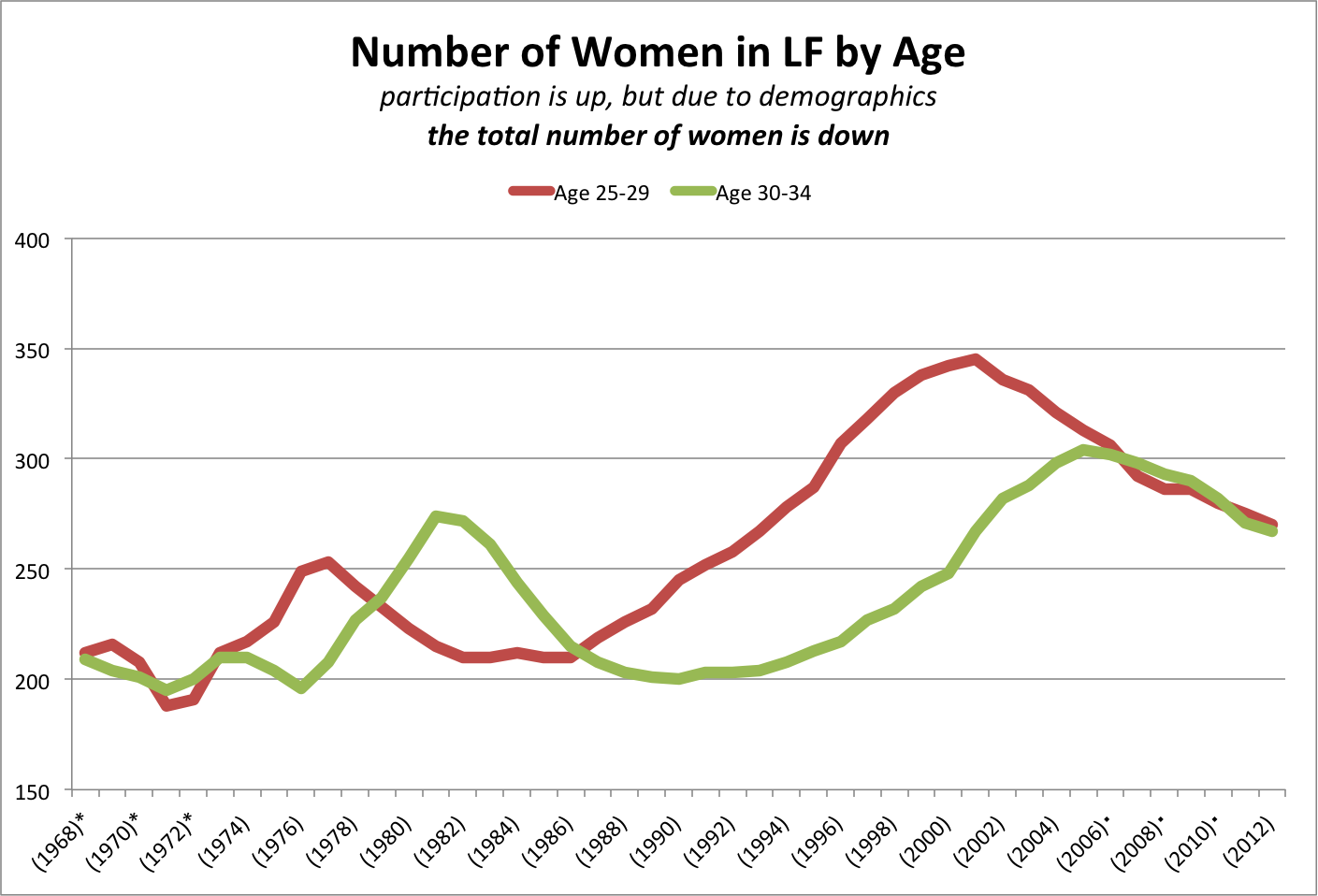
ImageA concurrent set of posts on the NBR Japan Forum is on the role of women in the labor force. At younger ages, the shift towards greater participation is dramatic, a 30 percentage point jump among 25-29 year olds. Participation for women age 30-34 is following in parallel, with about a 13 year lag:
ImageHowever, this is less economically meaningful than at first glance. Women are not going to be able to save Japan from its demographic challenges. Of course it is these very same women who are not having lots of children. But more to the point, these young women are now the only daughters of an already smaller generation of women.
So even a continued increase in women pursuing careers — already apparent among younger women — will only have a modest impact on the shrinking of the labor force. There are simply too few in these age brackets, and the number is falling yearly. Hence despite the rise in participation, the total number continues to decline:
Policy changes could smooth things, and from a microeconomic perspective (and a lifestyle perspective) could bring many benefits, particularly to women. [For an amusing portrayal of the challenge of a stay-at-home father, albeit in a US context, see Kim Stanley Robinson's Forty Signs of Rain.] But from a macroeconomic perspective it's too late for less male-centered policies around the workplace and the home to make a difference.

For the Japanese auto industry – by which I mean the industry located in Japan – this has strong implications. First, this is one of the underlying changes reflected in a set of graphs I posted on the future of the auto industry in Japan: firms hoping to sell cars face a shrinking market. It also means that recruiting workers will be harder. In Japan (unlike in China and India) families do not engage in sex selection (aborting girls), and the change in the number of young men in the labor force is likewise declining. (Indeed, because the participation rate for men has long been near 100%, the drop is more rapid as there has been no offsetting rise in the proportion of men working.)

This shows up too in technical fields; the number of engineers is down 15% from peak and casual observation (academic 2006-7 at Chiba University, a strong engineering school) is that many of those in technical fields are international students. Unless the auto industry (by which I mean suppliers, who generate two-thirds of employment) globalize, they will cease to be players, lacking the engineering clout to stay in the game. And if the unsuccessful efforts of my son (as a TEFL-certified teacher) to find an English teaching job in Japan are at all representative, young Japanese are not learning English. Meanwhile, of course, Honda and Toyota already employ 1,000 or more at their technical centers in the US. As businesses, they are positioning themselves to draw upon a global pool of engineering talent. That however does not help the Japanese industry.

Friday, August 23, 2013

World Cars, World Trade

GM is positioning Buick as a global brand drawing upon global product. As we've earlier blogged, this will work only if there is a convergence in tastes across major markets that allows the same vehicle to be made and sold with only minor modifications. Now the brand name may not be the same; what is a Buick in China may be an Opel Mokka in Europe and not sold in the US at all – though in this case the Buick Enclave is, as detailed in this Bloomberg article.

homologation and lower tariffs would benefit us

This isn't just to lessen risk (though in the case of China, that's been upside risk!), as argued in Spreading out for a little elbow room, a post by one of my students. Partly it's a story of platforms, as a manufacturer enjoys economies of scale when the same underlying vehicle can be tweaked. But ideally it's about selling the exact same vehicle on a global basis. That then works to the benefit of global suppliers (and to the detriment of medium-sized suppliers in Japan and elsewhere that have a narrow geographic footprint), as an OEM can ask them to supply the same part everywhere, down to the plastics and steel and so on that if allowed to vary can introduce defects, defects that are thus subtle and hard to diagnose, or add on to costs for local redesign and retesting.

At present, however, there are limits. The Insurance Institute for Highway Safety imposes crash tests that are unique to the US. Europe has its rules for pedestrian impact. Headlight standards vary, and require redesign and recertification. A standard approach in Europe – lights that track as you turn, and adjust vertically ascending and descending hills, are not always allowed in other markets. And providing those functions interacts with styling. So homologation of such rules across markets can bring big benefits.

So watch for what happens in the newly launched trade talks between the US and the EU, the Transatlantic Trade and Investment Partnership, as well as the on-going Trans Pacific Partnership talks with Japan, Australia and others. How autos are treated could be a boon to the US industry.

And by the US industry I don't mean just the Detroit Three (though if we're precise, only GM is headquartered in Detroit, reflecting a long-run trend to exit the city). Michigan is the leader of exports within NAFTA, both to Canada and to Mexico. BMW in Spartanburg, SC leads the auto industry in exports, and has just completed a $900 million expansion. (I've been through their paint shop, which includes a PACE Award-winning innovation from PPG that eliminates an entire oven.) But Audi is opting for Mexico because as an exporter they find it a better location for the range of available free trade agreements and resultant lower tariffs. (Audi's plant will be the only one to make certain products, as discussed in The Tariff Advantage of Mexico.)

So homologation and lower tariffs would benefit us, and benefit others. We'd presumably have to lower the temporary 1963 "Chicken War" tariff on light trucks that's still in place 50 years later. But while there is convergence across markets in what people drive and in styling – as our students heard in the spring from J Mays, Ford's Chief Creative Office, reflected in their notes here and here – that convergence is not complete. Japan's "minicar" market is deeply entrenched; so are big pickups in the US. So it's really not credible threat to the Detroit Three, who hold a lock-grip on pickups (Toyota has about a 6% share, Nissan closer to 1%). There's nowhere imports could come from. So as I see it, we'd benefit from these agreements. We might see some low-volume vehicles that for now are found only in Europe, because of the cost of adapting to US standards. Low-volume however is the crucial adjective.