About The Authors

Tuesday, April 8, 2025

Substack and SeekingAlpha articles: April 2025 update

While I am no longer active at Blogspot, I do post substative articles regularly on SeekingAlpha (behind a paywall), and on Substack.

My substack posts so far in 2025:

  1. Three Strikes and You're Out: Strategic Challenges of the US Auto Industry – are they (GM, Ford, Stellantis Chrysler) out?"
    July 19, 2025.
  2. Tesla in Europe: legacy makers are leaving them in the dust ... with production far below Berlin's "over 250,000" annual capacity
    May 21, 2025
  3. The Ascent of China's Private Car Firms ...and the collapse of its national champion State Owned Enterprises
    May 13, 2025
  4. Buy Here Pay Here: Paying Cash for Clunkers – With A Nod to the New York Times
    May 6, 2025
  5. Reshoring: What it Takes to Build a New Factory – Or why we won't see a rush of manufacturing returning to US shores
    Apr 16, 2025
  6. Clunkers for Cash: The impact of tariffs on used car owners Apr 6, 2025
  7. The Trump Tariffs: A Great Inefficiency Machine – His tariffs will neither generate the desired revenues nor revitalize American manufacturing Apr 3, 2025
  8. China: A Price War? – maybe not! Discounting is rampant, but in line with changes in supply and demand Mar 21, 2025
  9. To Borrow or Not to Borrow: The Dilemma for USMCA auto manufacturers – Between Scylla and Charybdis Mar 5, 2025
  10. China Update: Tesla's Prospects – a precis of an article published yesterday on SeekingAlpha Feb 25, 2025
  11. Confusing Fast Followers with "IP Theft" – it's illusory to think that automotive technology is protected by patents Feb 7, 2025
  12. Tariffs and Automotive: no one in the industry has a 25% margin, and the supply chain is only as strong as its weakest link Feb 2, 2025
  13. Close the Border: The Impact's Modest – a simple insight from basic Econ 101 analysis on why drug interdiction does not work Feb 1, 2025

My most recent SA articles are:

  1. Tesla February Update: China And Europe Steady, But No Prospects For Growth, Mar 25, 2025
  2. Tesla China: Grim Prospects For CY2025, Feb 24, 2025
PS Co-blogger Dave Ruggles has turned his retirement focus to guitar. That is part of the reason that I (Mike Smitka) have started an independent substack rather than continuing to post here. While I am mostly retired, I continue to write about automotive issues and attend industry conferences, as well as visit suppliers as a judge for the Automotive News PACE Awards (which recognize innovations by suppliers).
During COVID I learned to read Chinese, and have built a database of model-level domestic sales data for China covering over 1,000 light passenger vehicles, from January 2020 through the present. (I update data the middle of each month.) Each entry includes not just sales but also drivetrain, segment, brand, firm, price, and current discounts.
Along with the articles listed above, I have drawn on the database for a series of presentations at the annual GERPISA automotive research network conferences. While I've not finished sorting data, my presentation at the June 2024 GERPISA Bordeaux conference analyzed the geography of Chinese vehicle sales. I found that the sales of firms such as Guangzhou Auto but also Tesla exhibit a strong "home" bias. In contrast, BYD, VW, GM and Geely have strong sales throughout China.
On the GERPISA website you can find my analysis of the new model effect, the very similar size distribution of sales in China and Europe (eg, how important are the top 8 sellers in each market), how interactions between new and used vehicle markets explain COVID car price movements in the US, and the similarity in the geographic distribution of suppliers in China to those in North America and Europe.

Tuesday, May 21, 2024

Posts on SeekingAlpha and substack

I am (obviously) no longer very active at Blogspot. I do however post substative articles on SeekingAlpha, who pay me a pittance, which is more than google. Furthermore, my most popular SeekingAlpha articles get more comments than my average number of page views here. I have started posting non-stock-market oriented content on Substack. I will do so (note the originality of the title) at economicsandautos.substack.com. which I have now renamed smitka.substack.com, as, well, my name is unforgettable, er, shorter, and I will write on Japan, China, and other topics as the impulse arises.

My substack posts:

  1. The Wrong Firms Are Winning: China's Automotive Industrial Policy – Picking Winners is Hard for the Stock Market, and it's Hard for Governments Dec 20, 2024
  2. Automotive Reshoring is a Pipe Dream: Long Lead Times, Too Few Workers Dec 2, 2024
  3. Repo Man: Why He's Central to New Car Sales Oct 29, 2024.
  4. China's Policy Context: Crisis Management not Fundamental Reform October 19, 2024
  5. Why Entry into Making Electric Vehicles is Easy Oct 11, 2024. OK, it's the automotive industry. A friend in Silicon Valley cautioned that US$1 billion is a lot of money for a startup to raise.
  6. Manila and the Ridehailing Market: If you think your commute is bad... Sep 4, 2024
  7. Japan: Falling Population is a Challenge, Not a Crisis Jul 31, 2024
  8. Protectionism and Local Production: Tales of Excess Entry: EV Proponents, Be Careful What You Wish For! Jul 24, 2024
  9. The Rise of the Big Three: ...or How I Approach the Auto Industry July 16, 2024

My most recent SA articles are:

  1. China Autos 2024Q2: Zeekr and the Geely Group, July 15, 2024
  2. Tesla China: Counting the Competition, March 6, 2024
  3. Disruption and EVs: Tesla, Wuling and BYD, February 4, 2024
  4. China EVs and Tesla's Shanghai Challenge, September 26, 2023
  5. China EVs: Focus on Guangzhou Auto and Its Aion Brand, September 3, 2023
  6. China: EV Losers Will Multiply, May 28, 2023, and
  7. China's Automotive Slowdown, March 9, 2023.
PS Co-blogger Dave Ruggles has turned his retirement focus to guitar. Mike Smitka, mostly retired, continues to write about automotive issues. During COVID he learned to read Chinese, and now has a database of 4+ years of model-level domestic sales data for China covering almost 1,000 light passenger vehicles. Replete with classfications of drivetrain, segment, brand, firm and price for each model, it's enabled a variety of analysis. That includes a series of presentations at the annual GERPISA automotive research network conferences. While I've not finished sorting data, my most recent presentation, at the June 2024 GERPISA Bordeaux conference, was the geography of Chinese vehicle sales, showing that the sales of firms such as Guangzhou Auto but also Tesla exhibit a strong "home" bias. In contrast, BYD, VW, GM and Geely seem to have strong sales throughout China.
I've only put together data for a few models so have not yet posted my presentation to the GERPISA website. You can find previous analysis of the new model effect, the very similar size distribution of sales in China and Europe (eg, how important are the top 8 sellers in each market), and how interactions between new and used vehicle markets explain COVID car price movements in the US, and the similarity in the geographic distribution of suppliers in China to those in North America and Europe.

Tuesday, September 26, 2023

Europe's Crackdown on Chinese EV Exports

Mike Smitka
Prof Emeritus of Economics, W&L Univ
Judge, Automotive News PACE Awards for supplier innovation
Steering Committee, GERPISA global auto industry research network
Contributor, SeekingAlpha

Europe is poised to launch an antidumping countervailing duty investigation of Chinese EV exports to Europe. Launching is a political decision. Once the "go" is given, however, it turns into an administrative process that runs according to set rules. What matters is whether the lawyers involved find subsidies in China; they will. [You can find many details here on the European Commission Directorate-General for Trade website, including the link to a spreadsheet of recent EU cases.] It won't matter whether the EU provides similar incentives. Once launched, a guilty verdict is certain, and that could well lead to punitive tariffs that will bring an end to European EV imports from China. The process, however, will take several months, so might not affect European imports until June 2024.

The initial announcement focused on the threat from cheap EV imports from China, naming several of China's EV startups. But that's not how the process works. The EU plays by the rules, and those rules focus on an industry or product category, and in general not an individual firm. So the reality is that the real focus, intended or not, is Tesla. That's because they're the dominant EV exporter – all of Europe's Model 3s come from Shanghai, and many Model Ys. Stopping those exports from Tesla's Shanghai plant will not only lessen the pressure on the German car companies and their high-priced EVs. It will also force Tesla to turn up the volumes of production of the Model Y in their plant in Berlin.

Other EU firms will be caught in the cross-hairs. The Dacia Spring EV comes from China; Dacia is Renault's lower-price brand. Some BMWs and Volvos come from China. Their volumes are still modest – the Spring sold just over 5,600 cars in August – but their plans are expansive. Tesla's volumes, however, aren't trivial. Over the past 12 months Tesla sold 103,000 made-in-China Model 3. I don't have detailed data for made-in-China Model Ys, but I conservatively estimate half of the 200,000 Tesla exported the past 12 months made their way to Europe. At 1 million units a year, that output represents 20% of their Shanghai plant's capacity. In other words, without exports to Europe the Tesla plant in Shanghai can't surpass the 80% utilization level that is the auto industry rule of thumb for being profitable. Making cars, after all, comes with high fixed costs, and the irony is that the lower the wage level, the more plant-level fixed costs matter. Tesla now sits in the normal position of a car company with aging product: cut prices to maintain sales and capacity utilization or keep prices high and see sales plummet. (There is after all what the media calls a price war going on in China's EV market, touched off by none other than Tesla.) Either way, margins collapse. Fortunately Tesla's starting point is one of good margins, so that alone won't push the company into the red. But it does undermine the case for investing in Tesla's stock.

I add further detail in my Sept 26 article on SeekingAlpha. First, I provide underlying data. One key observation is that the era of rapid growth for China's EV market is over. Market expansion will no longer allow EV makers to see sales expand despite keeping prices high. Tesla has launched a refresh of the Model 3, produced for now only in Shanghai. The Chinese auto press however pans it as not worth the most prominent new feature, a higher price. And things will look much worse if the slowdown in the Chinese economy expands from real estate and shadow finance merchants in China's lower-tier cities to the wealthier metropolitan areas such as Shanghai where most EVs are sold.

Addendum: I continue to look into the process, and previous EU countervailing duty examples. The calculated subsidy will be the sum of national level subsidies such as reduced income taxes, provincial subsidies and local subsidies. Those individual items of 1% here and 0.5% there can add up to a significant total, the 19 line items for Chinese truck & bus tires add up to 21.97% (min) and 75.91% (max), so the bottom line in that case is substantive. The DG-Trade does not substantiate every claim, or finds some below the threshold to do detailed calculations. And the geographic variation of policies in China mean that the final CV duties will likely vary from firm to firm, as the industry is spread across a wide swath of China.
There are many issues. How will they treat the free license plates for EVs in 8 of China's largest cities? – I have no idea. If data aren't provided, what will they use as a proxy? One example of subsidized land for a factory in China uses the price of a similar sized site in Taiwan as the comparator. That may or may not be a higher price, but there's some incentive for the industry in China to cooperate lest the Trade Directorate choose arbitrary comparators that are unfavorable. However, recent Chinese legislation that classifies much data as "sensitive" may impede cooperation, lest company officials end up in jail for sharing classified information with a foreign government.
Out of the 432 line items in the database, 274 are for purported subsidies to exporters in China; many others are for India. As with antidumping cases, the steel industry generates multiple examples, but there are also ones for fiber optics, for commercial vehicle tires and on and on. br />Finally, one commentor on SeekingAlpha who has a Europe background believes the political decision has already been made. So now the devil will lie in the details.

Original article Sept 26, the final paragraph and other modifications addedd Sept 27.

Saturday, September 2, 2023

China's EV Market: 2023Q2 update plus an analysis of Guangzhou Auto and its Aion EV brand

Mike SmitkaProf Emeritus of Economics

In July the Guangzhou Auto (GAC)'s Aion brand was #2 in China's EV market, behind BYD but ahead of Li and Tesla. However, the EV market is no longer expanding rapidly, and macroeconomic stormclouds suggest the normal fall sales surge will be muted. Still, does investing in GAC make sense?

In an article published today (Sep 2, 2023) on the finance website SeekingAlpha, I argue that GAC will not continue its rapid growth, while the ongoing restructuring of its recently shuttered joint venture with Mitsubishi Motors should improve profitability. Two other joint ventures, with Toyota and Honda, also appear to be profitable, but again don't provide a growth story – they're only just adding EV assembly lines, so are also capacity constrained.

Management states that Aion is currently profitable, and that they anticipate an IPO. If that comes to fruition, it would make GAC more attractive, and might be interesting on its own. But that would await the ability to show a full year of profits, so I believe won't take place until next spring.

Now SeekingAlpha articles are normally behind a paywall, but you can try going here China 2023Q2 NEV Update: Focus on Guangzhou Automobile and Aion. My analysis draws on a database I've created over the past 3-odd years that has monthly sales data by model since Jan 2020, plus drivetrain, price bracket, brand, firm and segment. I read articles from the Chinese-language auto websites on a daily basis, and of course have overall background from 3 decades of research on the Japanese and North American auto markets.

Wednesday, March 15, 2023

Automotive Productivity: Plant Architecture

Mike Smitka
GERPISA Steering Committee
Judge, Automotive News PACE Awards
Prof Emeritus of Economics, W&L

This is the first little bit of an article on factory architecture, why it changed and its implications for the industry

I've both enjoyed and leared a lot from the substack articles at Contruction Physics. I've started thinking about how I would approach the same general set of topics for automotive. Starting on the construction end of things, early factories were fairly compact, because the use of steam power required locating things as close as possible to the power plant. The first factory I worked in was huge in length, to the point that bicycles were still used, but it was also built in 6 floors. If you look closely at the Diego Rivera Detroit Industry Murals, based on Rivera's first-hand observations in 1932 of Ford's Rouge complex in Dearborn, Michigan, you still see belts in use. Electric drive motors were pervasive by that time – Henry Ford worked at Detroit Edison prior to launching his first of three successive automotive startups in 1903. The transition, however, took decades.

Ford's operations when he started building the Model T were on the top 2 floors of a small building in what is today the Ford Piquette Avenue Plant in Detroit, a half mile north of the Rivera Murals at the DIA. It was an open hall with a series of work stands. At that time Ford relied on craft techniques, carting components made by outside suppliers up a freight elevator to be assembled by experienced fitters into a vehicle. A railroad spur ran up to the back of the building, essential for bringing in bulky and heavy engine castings and frames.
Now a museum, it makes a wonderful venue for receptions – we held the closing "gala" of the June 2022 GERPISA conference there, surrounded by Model T versions and "upfits" into pickup trucks, snowcats and so on.

Ford's first purpose-built factory, a few miles away in Highland Park, didn't come until 1910. It was a multi-story operation, but unlike Piquette was full of machinery, and from 1912-3, a moving assembly line.

Sunday, January 22, 2023

China's Population Decline: Not "News"

Mike Smitka
Judge, Automotive News PACE supplier innovation awards
Steering Committee, GERPISA auto industry research network

Prof Emeritus of Economics, W&L

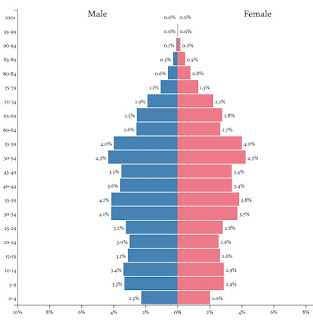
That China's population would start declining in the 1990s was a "done deal" a quarter century ago. By that point the One Child Family policy had extended the existing low fertility regime of China's cities into the much more populous countryside. The resulting smaller families meant that by 1998 the much smaller cohort of potential mothers under the One Child policy were themselves having few children. Meanwhile, urbanization meant that the number of families for whom a single child made sense was rapidly expanding, while a countryside where child labor was central to the well-being of families was fading. Between changes in target fertility for young mothers, and the cumulative impact of below-replacement fertility, future population decline was locked in place.

...that's China's population decline makes headlines is a surprise...

A bit more on the details. Maintaining a stable population requires that women average 2.1 surviving children, to ensure that there's at least one daughter to replace each mother. Since 1980, estimates of the "Total Fertility Rate" have remained well below 2.0 – even with the policy's many exemptions, families with 3 or more children remained a distinct exception. Hence a quarter century ago it was already clear that China's population would at some point begin to decline. Not only was the number of 15-19 year old women 6% lower than in 1980, the number of 0-4 year girls was 15% lower. By the mid-1990s the age of marriage had also risen, and teenaged mothers are now highly unusual. So by 1998, the mothers of the late 2010s had already been born, and were far fewer in number. Even if the timing of onset and rate of decline couldn't be pinned down without knowing how rapidly lifespans would increae (ditto subsequent fertility changes), the broad outline was there to be seen by anyone who understood basic demographics.

China's Population Structure, 1998
from PopulationPyramid.net

Of course we now know those details. Longevity did increase, and helped by very low child mortality, a girl born today can expect to live 80 years. Older Chinese are in no hurry to die! On the opposite end, however, fertility hasn't just remained low, it's fallen. As a result, the number of 0-4 year girls in 2022 is an estimated 40% below the number of young 20-24 year old women in 1991. Even if these girls go on to average 2.1 children – so far all evidence points to them not doing so – the number of mothers will fall through 2043. As the population pyramid shows, with today's girls the smallest cohort in decades, total population wouldn't start to stabilize for another 60 years, when that cohort of women starts to die off. Because China's population is so large, an option available to the US or the EU – accepting large numbers of immigrants – won't work. There simply won't be enough young people elsewhere in the world to fill the gap.

China's Population Structure, 2023
from PopulationPyramid.net

I've simplified the story. Not all women have children at age 20, and mortality rates vary with age and can predictably be expected to change as today's younger Chinese grow up with cleaner air and better drinking water, and are far less inclined to smoke. Of course they're also better fed and sedentary, which works in the opposite direction. Fertility rates will be different, even if the experience of Japan, Korea, and Southern Europe suggest they won't rise. Chinese exhibit a preference for sons, and by the late 1990s families engaged in selective abortions, so that the ratio of boys to girls rose 10 percentage points; the TFR thus needs to be 2.3 to guarantee that enough young girls will be born to replace their mothers. Aging likewise is uneven, tempered by the timing when larger cohorts reach their 70s. So demographers combine data on age-specific fertility and mortality to generate projections. Pandemics aside, those are pretty good over a 2-decade timespan. Thereafter the high-fertility, low-mortality case diverges from the low-fertility, high-mortality one. Still, the fact that every mother in 2043 has already been born provides a solid baseline.

That the likely population decline of 2022 makes headlines is thus a bit surprising. That the media coverage fails to focus on the consequent decline of the working age population, which is of the essence to future economic growth, is even more surprising. I know though from 3 decades in the classroom that the demographic momentum that comes from a population's age structure and birth/death rates is not intuitive. Even I, more numbers oriented that most humans, was once surprised by how much we know two decades in advance. It's also key to understanding retirement issues, and that too is not intuitive to a 20-something. As our societies age, though, it will come to dominate all of the middle- and high-income societies.

Addendum

That having a second child is viewed as challenging comes out in a January 24, 2023 New York Times article, "They Poured Their Savings Into Homes That Were Never Built" by Isabelle Qian and Agnes Chang. The article traces 4 individuals who took out mortgages to purchase apartments on which construction has ceased. Three indicate demographic implications: one a broken engagement and end of plans to have a child, and two who now "... can’t imagine trying to buy another home or having a second child," and a second who proclaimed that, due to the lost downpayment on a storefront property and continued mortgage payments, they are “... afraid to have another child. The income and expenses barely break even.” Nothing a government run by old men is going to do will enable such couples to have the three or more children necesary to reverse population decline.

Tuesday, August 23, 2022

Cars as Differentiated Durable Consumer Goods

Mike Smitka
Retired Economist
GERPISA Steering Committee
Automotive News PACE Judge

The investor site SeekingAlpha just posted my most recent article, Tesla's Thin Model Pipeline. That article is an application of the economics of differentiated durable goods to the auto industry.

First, autos are highly differentiated consumer good. Car company strategies reflect that, since Alfred Sloan organized General Motors to offer A car for every purpose..." (the ad is downloaded from the digital archives at The Henry Ford). More generally, use cases differ tremendously, from utilitarian transport to vehicles meant to display wealth. Work vehicles are even more differentiated, with up-fitters adding bodies to frame/drivetrain/cab sets for a multiplicity of businesses. We have small commuter cars, family-oriented SUVs, performance cars, and full-sized pickups with towing packages for farmers and others – I go past the Virginia Horse Center every time I head to town, lots of fifth-wheeler duallies.

Empirically, that suggests lots of models and a fragmented market. I use model-level data for Europe and for China (the world's largest vehicle market) to show just that. In Europe, no single model (or model series, e.g. the BMW 3-series) holds even 2% of the market, while over 400 models were available. In China, only 3 vehicles (barely) cleared 2%, while over 540 models were available. And these are just passenger vehicles. I don't have comparable data for the US, so I did a "deep dive" into the market-leading F-150 to show that it in fact consists of a family of models, suggesting that the upper limit for market share is likewise 2%.

The second piece is that vehicles are durable, with the average car on the road over 12 years old, and light trucks even older (from memory, 14 years). Used car sales are roughly 3x those of new. Hence new cars compete with used, and the more years a new car model is on the market, the greater the cannibalization from used cars. Henry Ford discovered that the hard way in the mid-1920s, as sales of the Model T fell despite repeatedly lowering the price. Ultimately Ford shut down production.

The economics literature on durable goods pricing is thin, and I know of only one set of studies that directly address that issue, from Adam Copeland of the NY Fed, solo and with various co-authors. Transaction data are hard to come by, the datasets compiled by various consulting companies are expensive and need to be cleaned up to handle rebates to consumers and dealers. That most new car purchases are accompanied by trade-ins further muddies the data. Their findings include an annual price drop of nearly 9%, and a shift down the income scale as a model ages. US consumers are well aware of these trends, and those on a tight budget time their purchases accordingly. Such consumers are also more likely to compare new and used cars. My son just bought a Subaru Legacy, and he shopped both. Given the current (August 2022) distortions in the market, he found that if he could wait, he could purchase a new car at MSRP, sticker price. If he wanted one immediately, he had to purchase used and pay above sticker. He could and did wait.

...to grow, Tesla has to develop a portfolio of new products and regularly renew existing ones...

Combine both of the above and the result is that car companies offer a portfolio of products that they renew on a regular basis. On SeekingAlpha I detail that as well, looking at the release cadence of new and refreshed models by the luxury car companies with which Tesla competes. As to Tesla, they have only one concrete future product, the Cybertruck set to launch in the summer of 2023. This year they've also refreshed the interior of the Model S. However, they've not updated the sheet metal on any of their existing vehicles – the Model 3 is overdue for that – nor have they announced any future product, only vague promises to come out with a limited-volume Roadster. Furthermore, I detail the limited market for pickups in China and Europe. The Cybertruck may do well in the US, but it's not a global vehicle. The stock market values Tesla as a high-growth company. However, they have revealed no strategy to develop a portfolio of products or to regularly renew existing products. My analysis indicates they can't grow without doing both.

Tesla appears likely to launch the Semi in 2023, but that is not a passenger vehicle and again is aimed at the US market.

Tuesday, August 2, 2022

China's NEV Market: Rising Segments, Falling Segments will generate winners and losers

Mike Smitka
Prof Emeritus of Economics
Automotive News PACE Awards Judge

I've been tracking Chinese sales data for a couple years, and pulled together thoughts in a brief article, China NEV Segment Analysis, on the finance website Seeking Alpha. The midsized segments, both sedans and SUVs, are stagnant. That's where Tesla's Model 3 and Model Y compete. In contrast, the compact "A" segments are expanding. Players there include one one startup, XPeng, but has BYD, VW and Geely as major players. To my surprise, I also find SOEs with decent shares, particularly GAC's Aion [GAC is owned by the Guangzhou Municipal government]. Most of the SOEs have lived quite well off of profits earned by their joint venture partners, such as Toyota and Honda for GAC. Are these proper commercial ventures, drawing upon the experience of SOEs in designing vehicles and running factories? Historically the SOEs were poor at design and at marketing. Some of that is the home boy effect – you won't find many Aion vehicles on the streets of Shanghai or Beijing. I don't know the produzct, I'm not a "car guy," so maybe these are real ventures properly run with earning money as a goal. But they could also be the result of party hacks pushing management to follow the EV trend, using their joint venture profits to make up for a lack of business acumen (and a very crowded market).

I also argue that the car market faces many headwinds. China has worked through the demographic dividend generated by falling birth rates, but now the working age population is shrinking, and probably the overall population as well. It's easy among the monthly NEV sales hype to overlook that the overall Chinese car market peaked in 2017. Then there's the end of the real estate bubble, evidenced by the failure of Evergrande, and the prospect of continuing lockdowns, an ironic side effect of China's initial success in using a combination of testing, contact tracing and quarantines to suppress the pandemic. There's no concrete left to pour after the huge infrastructure expansion that kept China from suffering the worst effects of the US real estate meltdown. That ammo has been depleted, and while Beijing talks about boosting car sales to offset the slowdown, consumers can't sell the condo that represents the biggest part of their life savings, and on top of that are worried that their bank may be the next one to shut its doors.

In any case, it will be interesting to see who does well in the NEV market, which just (barely) set a new sales record in July of 560,000 units. I think it's the bigger players who will fare well. VW's R&D spend is $3.6 billion a quarter; that's more than the combined revenue of XPeng and Nio, two of the current "pure play" EV favorites. Cars are in the end a consumer product, and having a broad, regularly refreshed portfolio of models on offer is of the essence. So my belief is that in the end the global OEMs will do well, and one or more of the private Chinese car companies: BYD, Geely and Great Wall. BYD is already in 6 of the 9 segments I tracked, as is Geely. VW, despite its late start, is already in 7. They cover most of the bases already. In contrast, Tesla can't seem to get new product out the door, and is stuck with but two models, and those in the stagnant mid-sized segment. They aren't heading towards failure, but they do risk being left in the dust as an also-ran.

Friday, April 8, 2022

Car Price Inflation: I Expect a Rapid Reversal

Mike Smitka
GERPISA 2022 Planning Committee
Automotive News PACE Judge
Prof Emeritus of Economics

Auto industry researchers, journalists and others, please consider attending the June 14-16 GERPISA conference in Ann Arbor, Michigan. A one-day price is available for locals who don't want to attend the full conference. A Tuesday dinner/reception and a Thursday Gala at the Ford Piquette Avenue Museum in Detroit. Breakfasts and lunches included. Morning events will be available to virtual participants; afternoon events are aimed at those attending in person. Go to GERPISA.org for details.

New car prices – and dealership profits are at record highs. Base models are unvailable, and high used car prices add to the mix. From another angle, the two line items are the biggest elements driving our 7% inflation rate. I believe, however, that "normalization" – greater availability, softer prices – will be sudden, muted only by the low level of cars flowing into the used vehicle market by car rental companies and other fleet operators. Why? – the market for high-end vehicles just isn't that large, so the shift from sticker-plus to discounting will occur over just a few months. Once it does, car makers will face a stronger incentive to produce vehicles with less expensive trim levels and in less expensive price segments. They won't have to discount the latter immediately, because such vehicles simply haven't been available. That won't last long, perhaps another 6 months.

To understand my logic, it's necessary to step back and look at the dynamics of the market since the onset of the pandemic. New and used markets are tightly linked, and the sources of "new" used cars (that is, sales by first owners) are part of the story. Yes, there's a chip shortage, and a war. However, that's but one factor, and you should be wary of such simple explanations. Analytics would be much simpler if we lived in a monocausal world, but we don't.

I'll put an arrow chart at the bottom, but I think a chronological exposition highlights the multiple feedback effects and channels of causation. So grab onto your seats, here we go!

  1. The initial total shutdown froze both production and sales. Nothing happened – except in the used car market. Without business travel, Enterprise, Hertz and their peers were lift with fleets of cars that lost value by the day. We're not talking small numbers – Enterprise had about 2,000 vehicles just at the Detroit airport, and nearly 200 at their rural Rockbridge County, Virginia store, to serve a population of a mere 35,000. It didn't help that a couple of these companies were in poor financial help. What resulted was a fire sale, as rental companies "de-fleeted" as fast as they could, even if it meant booking a loss on the vehicle. Used car prices crashed.
  2. However, that process ended once fleets had been slashed. In a normal year Enterprise buys 1 million new vehicles, the world's single largest purchaser. The flip side is that they also normally sell 1 million used vehicles directly to consumers and dealers, or dispose of them through used car auctions. Now none were flowing into the market. Consumers weren't driving much, remote work lessened commuting and attendant accidents, and with fewer new cars being sold, trade ins were also lower in number. Consumers who normally bought used cars held onto their cars longer, too, so that source also fell.
  3. When demand returned, prices had nowhere to go but up. With used car prices rising at their fasted rate in history, demand shifted to new cars. Well, new car prices rose, initially because discounts shrank, and then vanished. Enter fleet purchasers. Normally they would opt for lower trim levels and include a higher mix of sedans than the overall market. But car companies weren't willing to discount those, or even to produce them. Instead they had to hold onto cars longer, and try to offset higher purchase prices on the SUVs they did buy with higher rental prices. So while there were more tradeins, the huge flow of one-year-old, moderate mileage rental vehicles of pre-pandemic times didn't return. Meanwhile used car purchasers found they couldn't afford to get rid of their old ride for one that was a bit new and more reliable.
  4. You have surely noted that I've not mentioned supply chain problems. That's because I believe they are secondary to the interactions of new and used vehicle markets, and the flow of used vehicles. Lost production hurts, because when car companies are constrained in what they can produce, they move upmarket in trim levels and vehicle segments. For those old enough to remember, that happened in Spring 1981 when Japan agreed to Reagan's "Voluntary" Export Restraint that limited Honda, Toyota and their competitors to a combined 1.68 million units. I was about to buy my first new car, and watched the price on a subcompact rise 25% almost overnight. I didn't have to buy a more expensive trim package. Instead, I was forced to buy add-ons, a paint protection package that began peeling within a couple months, from a vendor no longer around. Grrr. But such is common in today's market. Clearly chip shortages add to the price swings, but even if we didn't have them, I am sure we would have seen a sharp spike.
  5. So where is the market heading? Well, the dynamics I've sketched propped up the prices of luxury SUVs and fully-loaded vehicles. It won't take much to reverse that, because we all have run through stimulus money while wages aren't rising enough to push ordinary workers into the 15 million or so individuals with an income high enough to purchase a new vehicle. I've already heard from a couple reliable (but off-the-record) sources that big pickups and the largest class of luxury SUVs aren't selling. The rest won't be far behind.
  6. Now the permanent shift will come once car rental agencies are able to re-fleet. Hertz coming out of bankruptcy is in my judgement showing desperation in striking deals to contract for large numbers Tesla EVs and now Polestar EVs. (I suspect the actual contracts are rife with escape clauses so that the numbers prove more PR than a purchase commitment.) Again, I am reading hints of re-fleeting, versus none a month ago. Within 9 months those cars will be cycled out, because from then on it will be easier for rental companies will able to buy more cars. Prices for used vehicles will drop rapidly, and across the board.
  7. Note one implication: we will go from sharply rising new and used car prices to sharply falling ones in the space of 3-4 months. Gasoline prices are another major component for US inflation. Petroleum prices are set in global markets, and Russia is 11% of global production. The US is 20%, but is a modest net importer. So Russia accounts for a larger share of global exports. How much short-term flexibility do Saudi Arabia and the other Gulf states have to increase output? How leaky with Russian sanctions be? I don't know, but I don't expect further price increases. If so, then the two biggest sources of inflation will turn negative, and energy prices become neutral. I've already been surprised by how long inflation has lasted, but I remain convinced it's transitory.

I have opted to focus this post on the components of new and used vehicle markets, while shying away from data. OK, typically 2 or more used cars sell for every new car, and I can with some effort put specific numbers on that. It would make for a long and turgid post, or longer and less readable one. It's also very, very hard to get current data on fleet purchases and other components of a very dynamic market. I've also simplified, with no mention of interest rates or leasing. I don't believe my argument depends on such details.

From my presentation at the June 2021 GERPISA virtual conference.

Wednesday, January 19, 2022

Tesla China: Upside is Vanishing

Mike Smitka
Prof Emeritus of Economics
GERPISA.org 2022 conference team

The following appears on the SeekingAlpha finance blog. I wrote this last week, editorial approval took a long time due to COVID.

Were I to rewrite it, I'd probably start:

"...in 2021 Tesla exported an average of 15,000 Model 3's a month to Europe. At some point, though, Tesla Berlin will start production. Where will the Model 3's go? – they're in the "B" midsized sedan segment in China, which is the slowest growing EV segment in China. Furthermore, within the segment Tesla lost market share quarter by quarter in 2021. So the one place they won't go is to Chinese consumers. They want SUVs and fresher vehicles.

Tesla China: As Good As It Gets?

Jan 19, 2022 03:09 PM | Tesla, Inc.(TSLA) | By: Mike Smitka

  • Tesla's CY2021 sales of 321,145 units are stellar, bolstered by December sales of 70,602 units. The good news is that the Model Y is holding onto its share in the "midsized SUV" segment, and that segment expanded 3.5x in 2021. CY2022 should be good.
  • The bad news is that the Model 3 lost share in the "B" sedan segment throughout 2021, and that segment grew the slowest in 2021.
  • With no new models until 2023 or later, CY2022 is as good as it gets. Read the full article now »

Thursday, September 23, 2021

Tesla, GM and BYD: Three China Strategies

Mike Smitka

SeekingAlph published an article by yours truly today comparing the stategies of Tesla, BYD and GM in the Chinese market. As you may know, GM has far and away the best-selling EV in China in the Wuling Hongguang MINI EV, which sold over 40,000 units in August 2021, and has held the top slot since launching in September 2020.

In the article, I noted that GM has a long history of leveraging successful inexpensive vehicles to sell more up-scale and profitable models, going back to the formative period of the 1920s under Alfred Sloan and his "a car for every pocket" product portfolio. But when I wrote the article, there was as yet no evidence on how they would do that for the Hongguang, which is made by the SAIC GM Wuling joint venture, but did not carry the GM logo.

Now we know: Wuling has a new logo, with GM at the center.

In my mind, that puts GM in a strong sales position in China, as the market for EVs expands by leaps and bounds. In contrast, Tesla has no coherent strategy, with only one "fresh" model (the Model Y) and an uncertain future for the Model 3. (We won't know until September EV sales data are out, because Tesla bunches sales in the last month of the quarter.) As a firm, they seem to be in no rush to build a product portfolio, and instead are placing a huge bet that the Model 3 and Model Y will remain strong sellers indefinitely. They amplify that with a US-centric product strategy: their next vehicle will be the CyberTruck, singularly unsuited to the Chinese market, where pickups are an unstylish niche. Worse, over 50% of Tesla's sales are in China's 10 largest cities, where the CyberTruck is an even worse fit. As a firm, their stock price depends on rapid expansion, which is only possible if they can gain share in China and Europe. With everyone but them launching product aimed squarely at the core market segments in China and Europe, that is not going to happen.

In contrast, BYD ticks all the boxes for success. They have a broad product portfolio, and a regular cadence of renewing old models. They have commercial vehicles (thanks to SeekingAlpha comments by MaxedOutMomma for the link to BYD's commercial products). They have broad geographic coverage. And they're currently the #2 EV producer in the world's largest market.

All for now, to not abuse SeekingAlpha's exclusivity. Look for a long, detailed article there in about a month. Note that my most consistent COVID lockdown project [alongside caring for 2 young granddaughters] has been to learn to read Chinese. I've progressed enough to follow Chinese-language automotive news on a regular basis. Well, the news output there is huge, so far my focus has been the new energy vehicle passenger car market – I've bookmarked about 30 sites, and look at a half-dozen almost daily. I'll be expanding my purview to include commercial vehicles. Consistent with that, let give a plug for Richard Doner, Gregory Noble and John Ravenhill's The Political Economy of Automotive Industrialization in East Asia, which includes a really nice chapter on China. Of course Peter Warrian and I also have a chapter on the Chinese auto industry in our 2017 book, link here.

Friday, August 6, 2021

Cars selling at MSRP is an outrage?

Mike Smitka Retired Economist and Judge, Automotive News PACE Awards for supplier innovation

This is an edited version of an overly long comment posted on "This Conversation With A Dealer Will Hurt Your Brain" on Jalopnik.com.

============

I am shocked, totally shocked, that someone should be asked to pay MSRP for a car. Surely you all routinely negotiate a nickel off of every ear of corn you buy from Walmart or Food Lion?? – “I wanted one a little larger, but for a bit of a discount I’ll make do with this one.”

Now to the world of a dealership in August 2021 in the US.

  1. In many regions of the US there’s excess demand for certain vehicles at MSRP. With a phone call, they’d be able to sell every vehicle on their lot to another dealer within the hour, without discounting or having to take another, less desirable, vehicle in return.
  2. Most dealers are in business for the long haul and thus don’t want to sell over MSRP because it won’t generate repeat business or service business. (Note all of the 18,000 dealerships in the US are well-managed, so those most vocal in complaining about dealers are likely encountering an exception. Or are the sort of customer who, at the end of the day, has annoyed others right and left.)
  3. So you as a dealer want to sell to someone local, as you have decided NOT to charge what the market will bear, and not to empty your lot today of all cars.
  4. So asking someone to come in is both reasonable and fair. If you aren’t going to raise your price and thus must turn away customers, then turn away the one who isn’t local, because you certainly won’t get their service business and you’re unlikely to get repeat business. (The Jalpnik writer was complaining about not being given a quote over the phone.)
  5. But you still have excess demand and right now you can’t get another dealership to swap inventory. You can’t replace that F-150 on your lot. (Change the model name to match the local market.)
  6. So what are you to do? You favor someone who has used your dealership before.
  7. You also favor someone who gets financing through you. For my last two cars, I got a better rate that way, too. My local credit union and bank weren’t competitive. But despite the lower rate, the dealership still got a finders fee – and I’d rather they got a cut on the deal than my local bank getting to pocket everything. The dealership was active in the local community, supporting this and that. The owner lived locally, as do the employees. But my banks ... they all now have their own foundation, to let them fund “socially responsible” ventures that they can trumpet in their investor PR. No money for the local food bank, or youth sports team.
  8. You especially favor someone with a good tradein, because used car prices are at a historic high. Some models are hard to find at the used car auctions of Manheim and Adessa, leased vehicles are being kept by their owners, and rental car companies are holding onto their current fleet because they, too, have a hard time buying new cars. So you can more readily make money on a tradein, if it's anything decent. You can give a bit of a discount, you can pay a bit over KBB or some other used car price guideline on the tradein, and have a both a happy repeat customer and a bit of profit. (The price increase there is the biggest component of the recent uptick in inflation in the US.)
======

Multiple comments assumed implicitly that dealerships don’t need to make money. Now in general dealerships don’t make money selling new cars. As a project for students I got a Honda dealership and a luxury dealership group (5 stores, 3 brands) to go through their financials with me and then the class. At best they earn enough to keep the lights on, even the luxury dealers. They survive because they operate multiple businesses under one roof – new (individual customers and local fleets), used (retail and wholesale), service (with "loaners" – effectively car rentals – as one component), parts (retail and wholesale), and finance and insurance, They need to run them jointly and competently if they are to stay profitable, as they all face competition. [As to the numbers: one was a local dealer with whom I had a longstanding relationship, who knew the numbers would stay confidential. The other was someone I knew from before he became a dealer, who also happened to have a son in my class that term. They brought inch-thick reports with them, the problem wasn't data accuracy, it was being overwhelmed by the data that comes with the complexity of a dealership.]

In normal times – Summer 2021 is NOT normal – US customers want a car, today. (In some countries, you have to order a vehicle, there’s no local inventory. Not here.) That means there’s a constant mismatch between what a dealer has on hand and what customers want. In normal times, dealers can swap new cars with other dealers to offset that, but it’s always better for them to sell what’s on their lot. (That’s on average, see my two examples below.)

Note, too, that on average MSRP is too high, because even if there’s high demand at launch, cars stay in production for 4 or more years, with a "refresh" at the midpoint. Over time a model has to compete with other, newer models that offer features unavailable at the relevant cost point when the model was engineered (think of things such as adaptive cruise control). Worse, after the first and especially the second year, it has to compete with used cars of the same model, as rental car companies "defleet," as leases expire, and as the more well-heeled customers decide they simply want something different. As a consequence, on average prices fall 9% per year. So -9% by the end of the first year, -17% by the end of the 2nd, -24% by the end of the 3rd, and a whopping -31% by the end of the 4th year. That's obscured because early vehicles tend to be fully loaded, and so well above base MSRP. Over time packages get made standard, 0% financing kicks in, and more vehicles are closer to base. Finally, as the replacement model launches and dealers work to clear their lots, we get the more visible discounts. Oh, and remember that you've never owned a new car: the moment you take possession (which, in some states, happens when you sign the last piece of paper, it's a used vehicle, and can no longer be sold as new.

Again, there's the average, and none of us is ever quite average. My last 2 new car purchases provide a case in point. For my wife’s CR-V, that was not a problem, as Honda only offered 3 trim levels and we didn’t want an unusual color. We were also local. [Unfortunately our trade-in was on its last legs and it died on the dealer’s lot. If only it had waited one more day...] For my Chevy Cruze, I wanted a stick shift, and across the entire region there wasn’t much inventory, so I had to pay a bit more [mainly in time and travel], and compromise on color. You all can think of your own variation, the closer your “drive” is to the high-volume commodity end of the market, the less varied the pricing. The more idiosyncratic, the wider the price quote and the more painful the purchase process – for me and for the dealer, who may only discover after the fact that by not giving me a good price, they ended up with that stick shift on their lot for another 9 months, which with floor plan and insurance and other incidentals put them into the red on that particular vehicle.

Finally, this world is shifting with online retailing. In some states, but not all, fully contactless sales are possible, there’s no notarized document that has to be signed in person. So as noted, new car sales aren’t profitable (given overhead), and the margin on used cars has been compressed, with wide variation because it’s a much harder business to manage. Service volume is declining, and has been for two decades as intrinsic quality is increasing. With increasing complexity, however, dealerships aren't losing market share. EVs won’t change the trend: with 280+ million registered vehicles in the US, even strong sales won’t quickly shift their share of of the “parque”. Walmart, Costco and others are entering the market, and certainly they can bring scale and online skills to the sales end. I don't view that as a threat to dealers. Why? – it's a thin margin business, full of hassle. Walmart is of course used to thin margins. I believe, though, they're in for an unpleasant surprise on the hassle. Meanwhile, the number of dealers in the US will continue its slow decline, as the less well-managed exit. Again, that's obscured by the way things are reported: the number of stores isn't falling very rapidly, but the number of stand-alone stores is, as 5- and 10-car dealership groups become more common.

Thursday, April 29, 2021

China's Auto Industry: There Will Be No Winners in the EV Race

Michael Smitka
Prof Emeritus of Economics
Judge, Automotive News PACE Awards (for supplier innovations)
Steering Committee, GERPISA global automotive research network

Please read my post on China's EV industry on SeekingAlpha, an investment blog.

Here I summarize a few points covered in my SeekingAlpha article published this morning, and provide data in a more readable format – I found it hard to reformat tables on SA for readability. I will also try to provide more data on the new model effect, and a foretaste of a planned SA article on the Wuling Hongguang.

...the success of the Wuling Hongguang is great news for the environment...

First, here is a nicer table on segments. The data come from different sources, which obviously categorize vehicles differently. So it's suggestive. For reference, the Tesla Model 3 is a "B" segment vehicle, and the Model Y is a "B" segment SUV. The Model Y in particular faces a lot of competition, while the Model 3 is getting stale and appears on Chinese automotive websites only with reports of quality issues. Profits will be hard to come by for all players, but that's generally the case in the automotive world, which is cyclical, capital intensive and generates thin margins.

ClassAll ModelsEV ModelsMarch 2021 EV SalesAll 2021 SalesEV Share
A00 微型车161464,189 61,333 105%
A0 2049,51547,27320%
A 紧凑型车942117,021467,5534%
B 中型车44438,251226,26012%
C 小大型车1617,95670,29311%
Sedans19045126,932872,71215%
A0 小型SUV64207,314136,7245%
A 紧凑型SUV1121515,148476,8663%
B 中型SUV791519,018227,5508%
C 中大型SUV2047,58831,35024%
MPV3941,26375,7022%
SUVs31458 50,331948,1925%
Passenger Vehicles504 103177,2631,820,90417%

But first, EV sales dominate the minicar segment, the most prominent of which is the GM Wuling Hongguang MINI. My thoughts on why that's the case lie below. Second – ignoring the very small A0 car and the luxury C class sedans and SUVs, the other segment with high sales is the B segment, where the bulk of China's higher-priced models are found. In other words, EVs sell in the minicar segment, and in high-priced segments.

Second, the EV market is quite large, but the small share in several segments suggests lots of room for growth. But why are sales in the A segments of sedans and SUVs so small? It's not for a lack of models. I argue as well that that's for the same reason that the A00 segment sells well.

Here's a neat photo that shows just how small the drive motor can be for a very small car:

The key is costs. Minicars, due to their small size and their target at commutes (with ranges of just over 100 kms) allow them to be built and sold on a commercial basis. However, all other segments try to address a wider market, emphasizing range (or rather range anxiety.) That leads to a viscious circle: range requires a big battery, batteries are heavy so those vehicles also require a more robust frame and suspension, which adds further weight. And both add cost, including beefier drive motors and drivetrain components that can handle higher torque, and more capable power control modules. Quite simply, EVs are more costly than ICEs, and sell only when large subsidies are available.

In practice, that means EVs only sell in cities that impose license plate restrictions in the name of controlling congestion. While 71 Chinese cities have over 1 million registered vehicles, it's only the Shanghai's and Beijing's of China that impose operating restrictions on vehicles that lack local "Class A" license plates. This is similar to London's restrictions on vehicles entering the center city. Now those cities allocate some plates via a lottery, but the chance of winning is very low (0.5% in Hangzhou in February 2021, for example). So in practice car buyers must buy a plate at auction, which can run up to $12,000. That's enough to offset the high prices that EV makers need to charge to cover costs.

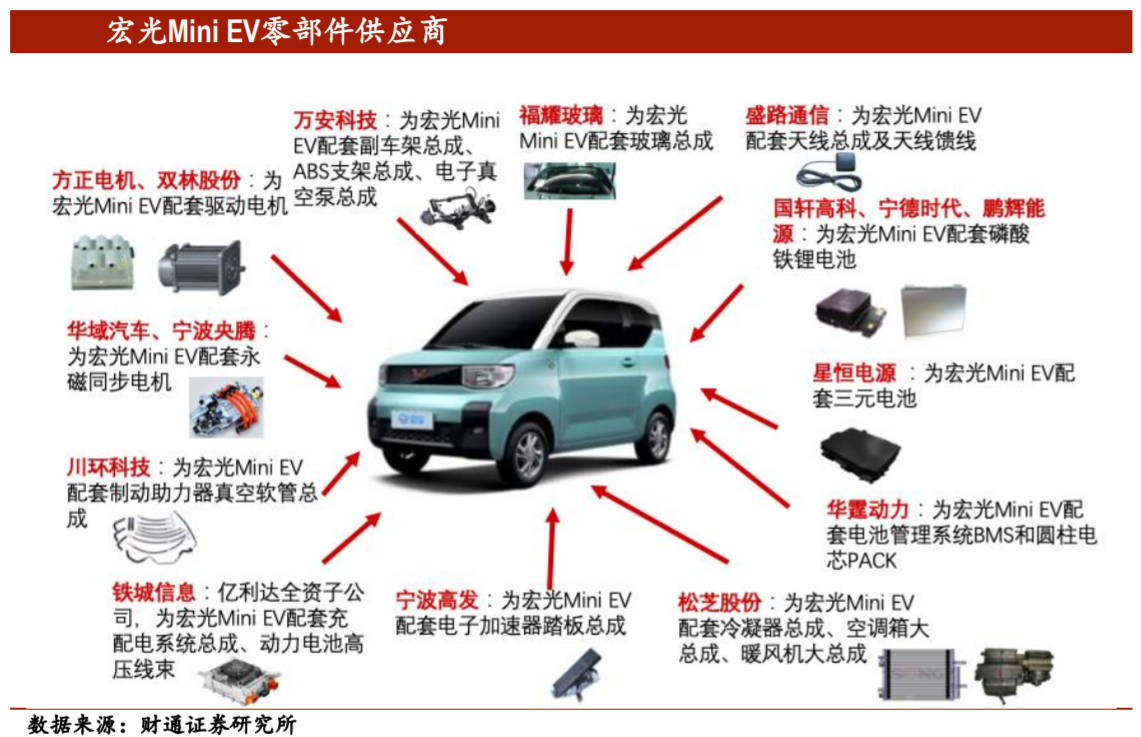
Then there are the A00 models. Perusing descriptions of the vehicle on an array of Chinese-language websites suggests that the Hongguang uses 3 batteries: a standard lead-acid one to run lights and infotainment, and an LFP one supplemented by a small NCM battery. Furthermore, GM uses 5 different suppliers for those batteries, they have enough volume to avoid making themselves beholden to a single supplier.

All of this means that A00 EVs are commercially viable without subsidies. They have a vast potential market in the countryside, where dedicated parking / access to an electric outlet are less problematic. They also fit the use case, the top two of which are short-range commuting and taking your kid to school. They're a great 2nd car. Both are points made in surveys cited in the latest "blue book" on the Chinese NEV market, 中国新能源汽车大数据研究报告 (2020).

But will this market generate a "winner," to match the current mindset among investors? No, because there will be a lot of players, and because even if profitable, per-unit profits aren't great on a vehicle costing well under US$10,000.

However, from an environmental perspective this is great news. Large, long-range EVs aren't great for the environment, even if the rise of "green" electricity means that in more and more regions of the world they are probably a modest increment over a gasoline-powered car. Chinese consumers are discovering that a very small vehicle actually meets there needs. We can hope that consumers in the EU and US make a similar discovery, as surveys make it very clear that most round-trips are short in distance and involve at most one passenger. So while it may not be a great boost to GM's bottom line, the Wuling Hongguang is a major step in improving the environmental footprint of vehicular transportation.

Sources:
  1. getting out of car https://n.sinaimg.cn/sinakd2020123s/120/w1081h639/20201203/0fc5-ketnnaq7361120.jpg
  2. small size of drive motor http://www.020h.com/uploadfile/2020/0801/20200801103440585.jpg
  3. cutaway of chassis / componentry: http://www.020h.com/uploadfile/2020/0620/20200620032359548.jpg
  4. supplier list https://n.sinaimg.cn/sinakd2020123s/278/w1141h737/20201203/de0c-ketnnaq7361124.png

Tuesday, February 23, 2021

The Automotive Model Cycle: The Battle Against Fading into Irrelevance

Let's play around with the model life cycle. It's fundamental to the industry, indeed we see it in other consumer durables: computers, cell phones, cameras, bicycles, skiis, exercise equipment. Then there's clothing – in most statistical systems, clothing is classed as a current consumption good, but I've t-shirts I've been wearing for 20 years, and dress shoes that are even older. The only reason to buy new clothing is so that I don't look my age. (Yeh, dream on...)Note 1

...what you see: information on the latest models...

The life cycle is intimately connected with the concept of progress, and it's linked as well to the differentiation that comes from being in fashion, and the influence of what's fashionable on how we look at things. But rather than delve into the abstract, that newer is better, and that as social creatures style matters, here I reflect upon the process a car purchaser goes through, and how that leads to valuing the new.

So how do you go about searching for your next car? And you do search, because it's an expensive purchase, and model characteristics mean that some won't fit your normal use, and they won't fit your wants. Even if you are part of the minority that limits yourself to a new vehicle, there are roughly 350 models available at any given time, each with multiple trim levels. Pickup trucks are the extreme case. With the Ford F-150, do you want a 5-1/2, 6-1/2 or 8 foot bed? Now if you want that 8' bed, you can't get the SuperCrew® with a full second row. Oh, and there are engine choices, for that 8' bed SuperCab you have 3 choices. There are multiple towing options, multiple driver assist camera options, and infotainment packages. You need to sort through all this.

So you turn to the many car sites and car mags. Support your friendly automotive journalist! They make the round of the auto shows and early test-drive road-and-track meets, all while being dined and wined (in that order, no drinks before getting into one of our five pre-production test vehicles dedicated to PR). Having had a fun day or three, it's off to write. Automotive News has AutoWeek. Then there's Car and Driver, Consumer Reports, and on and on. Go to Europe, or Asia, and you see the same. During 2019, before Covid set in, I was in train stations in Italy, France, Germany, Korea and Japan. Kiosks all display a rack's worth of car (and computer and camera and fashion) magazines, to guide the purchaser. Want an EV? Then buy the Green Car Magazine and read through their Praxistest [it's a German, not an American publication]. Want to off-road? Every country seems to have at least one publication devoted just to that segment.

Then there are the online resources. If you're in China, the world's biggest new vehicle market, you might go to Gasgoo to look through their new car reviews. (Those aren't available on Gasgoo's English-language site.) Alternatives include the auto section at 163.com, which resembles visually the car review portion US sites such as Edmunds.)

Now, think about what you see: information on the latest models. Yes, if you want to find information on that car that launched 2 years ago, you can find it. But maybe not in the latest issue of MotorTrend that you picked up at that 7/11 at your local gas station, or in the latest episode of Autoline Daily. What you find most readily is information on what's new.

Now at present automotive technology is changing rapidly. My wife's car doesn't have an autodimming mirror, my slightly newer car does. Mine has a turbo, and gets vastly better gas mileage. I would really like adaptive cruise control, but back then it was only available on cars above my target price range. Now it's pervasive. I really appreciated the heads-up display on a rental car in Germany, particularly as it kept track of the frequently-changing speed limit on roads around Freiburg. Since I seldom drive in places I'm not familiar with in the US, it wouldn't be high on my wish-list. But the diffusion of driver assist systems, and the 2+% annual increase in fuel efficiency, mean that new really is better.

Of course styles also change. In the US, pickup trucks outsell sedans. I do own a pickup, but I live in a rural area, unpaved roads included, and have to cart things to the garbage dump myself, and then there are downed tree limbs and DIY construction projects. But are pickups really needed in the suburbs? No, we want to stay in fashion. We may not notice new cars as new, but no matter how pristine in upkeep, we certainly recognize 10-year-old cars as old. I certainly do, and I'm hugely uninterested in fashion, I'm an industry nerd, but not a car guy. But survey the range of car mags, and it's clear that I'm the exception, not the rule.

There's another influence at work: cars are durable goods. The longer a model has been on sale, the more plentiful the used cars become. This was well understood in the 1920s, when Ford's biggest competitor for his sole product, the Model T, was not an offering from General Motors or Hudson, but a used Model T. Companies adopt two strategies. One is to phase out old and launch new models on a regular basis. The other is to reduce prices as a model ages. An example is a study from the Federal Reserve, "Prices, production, and inventories over the automotive model year." They find a 9% annual drop in prices. By the end of 3 years – remember to compound! – that is a 25% drop in price. Even with the reduction in costs over time, with the amortization of the fixed costs of development and tooling, that rate destroys profitability by the 4th year or so. A mid-cycle "refresh" helps reset prices, but it only helps. Car companies need the new to stay in business.Note 2

All of this comes together, mutually reinforcing our focus on new models over old. It shows up in how we shop. It comes from our sensitivity to style. It's reinforced by car company's product strategy. It's reflected in the vast array of car magazines and car sites, found in every market. Finally, it's a challenge to every new entrant to the industry, the Geely's and Tesla's of the world, who need to finance work on replacement models even as a new car enters production. For Tesla the Model 3 is already old hat, what those searching for an EV will find is – today's headlines – the forthcoming Hyundai Ioniq.Note 3 Dig a little further, and you'll find reviews of the Model Y. Even though the Model 3, Model S and Model X continue for sale, for all intents and purposes Tesla is car company with but one model.

To sum, models sell best at launch. That's particularly noticeable in China and Japan, but there's certainly plenty of hoopla in the US. So keep the new models coming. And from an industry perspective, start production with the high-margin models, and pray that the launch goes well, because the PR begins well before the target date.

Notes and Digressions
  1. Clothing is now so inexpensive that ordinary Americans have a "wardrobe" – but if you pay attention, older houses didn't have closets, all one's clothing fit in a piece of furniture called a "wardrobe." Our house has walk-in his-and-hers closets.
  2. There is an empirical literature on how car prices decline across the model cycle. See Copeland, A., Dunn, W. E. and Hall, G. (2005) Prices, production, and inventories over the automotive model year. Finance and Economics Discussion Series 2005–25. Board of Governors of the Federal Reserve System (U.S.). Available for download at https://www.federalreserve.gov/pubs/feds/2005/200525/200525pap.pdf
    Subsequent studies using more recent data find a similar 9% rate of price decreases.
  3. First up on Gasgoo is Hyundai's Ioniq 现代汽车IONIQ(艾尼氪) 5全球首秀 开启环保电动出行新时代. On the German Green Car Magazine, it's the "Volvo XC40 Recharge Pure Electric AWD im digitalen Dialog. And so on. But there is a pure news story on the Tesla Model Y, reporting long lines at dealerships and a wait of 4 months or more for delivery.

Monday, March 2, 2020

Coronavirus and the Chinese Auto Industry

Mike Smitka
Emeritus Prof of Economics, W&L
Judge, Automotive News PACE Awards (supplier innovaiton)
Steering Committee, June 2020 GERPISA / PVMI Joint Detroit Conference

The finance site SeekingAlpha has just published an article of mine on the impact of the coronavirus. They have exclusive rights, so I won't repost it here. I can though provide a synopsis.

  1. The Chinese industry accounts for about 30% of the global industry. The major global OEMs all have a presence there, as do the Tier I and many Tier II suppliers. All the big players have one or more R&D centers in China as well. Now the market has fallen the past 2 years, but for many global players it remains their single biggest market. For example, roughly 40% of VW's and of GM's unit sales are in China. For VW, Audi is a major luxury brand, so in some periods China has accounted for more than 40% of VW Group income. In CY2019 it generated $1.12 billion in income for GM, not including unreported licensing fees and profits on parts sales.
  2. 2020Q1 is already a disaster. January sales were down 19%. So far February sales look to be down over 90%. March sales will likewise be a disaster. Of course output has been zero or nearly so since the start of the Chinese New Years on January 24th. Since no one is buying cars – and China is a net importer of finished vehicles, not an exporter – it's just as well no one has been producing.
  3. Conservatively, this represents on average a 10% less top-line for global auto in 2020Q1 (no sales in February, which is one-third of the quarter). Realistically, given an unexpected drop in January sales, it's more.
  4. Going forward – we're now into March – things will remain grim. Why? China is in effect in a deep recession. Small business owners have had no income for 5 weeks or more, and their employees (if they still have any) haven't been paid for 2 months. (Historically you tried not to pay workers just before the New Year, because many either didn't return or used the holiday to switch employers.) But it's the Chinese bourgeoisie who buy cars. They can no longer afford one. March will go well if sales are only down 50% over 2019.
  5. Restarting production: A few workers, but no parts. Screenshot from Automotive News TV.

  6. Going forward, what of government stimulus? Well, what tools does the government have? In 2009-2010 they used indirect fiscal policy, by letting governments borrow to build infrastructure and sell land to housing developers. They also speeded up the construction of the national expressway system (now more extensive than that of the US), a high-speed rail network and lots of airports. There's now a lot of excess capacity, new suburbs with almost no residents, and on and on. President Xi has encouraged the rise to the top of the most syncophantic, not the most imaginative. They will try doing more of the same – building yet more unoccupied suburbs – but that will no longer work.
  7. Furthermore, stimulus won't help the bourgeoisie. Small businesses are poorly banked; monetary stimulus can't reach them. Instead they depend upon private lending, family networks and (above all) retained earnings. They also turned to real estate and unregulated investment trusts to park their wealth. Well, there's no way now to liquidate the 3 and 4 condominiums that many better-off Chinese own. Investment trusts tend not to have been professionally managed, even when they weren't dodgy. They're at best illiquid. So there's no way for help from Beijing to reach these businesses, and what these businesses have put aside for a rainy day aren't liquid in the current environment. So many will go out of business, and will also have lost their savings. They are not going to be buying cars.
  8. ...realistically, 2020Q1 automotive China top-line will be down two-thirds, which translates into a 20% top-line for global auto...

  9. In sum, the Chinese economy is in a very deep recession, and there won't be a V-shaped recovery. There wasn't post-1992 in Japan, there wasn't post-2009 in the US. Car sales are not going to bounce back. So it's moot that supply chains are not yet up and running. The industry doesn't need to produce more vehicles, while dealers sit on copious inventories.
  10. ...If you will need new brake pads for your car before summer, get them now!! Advance/O'Reilly/Autozone won't be restocked anytime soon...

  11. Supply chain issues will affect the North American and European industries. How much is unclear. Korean producers in particular are closely integrated to suppliers in northern China – it takes only a day for ships to cross from Tianjin to Incheon (though having flown over those shipping channels in November, congestion means it takes at least a day longer). It typically takes 4 weeks (and up to 6 weeks) for shipments to reach the US. But firms stock up in advance of the New Year, so the ships that should have sailed in early February are only now starting to not show up. (Pardon the syntax!)
  12. And now there's coronavirus in Korea, Japan and Italy.

On SeekingAlpha I provide more detail on the role of Hubei and Wuhan. Look at a map: they're part of the Yangtze River Valley, closely tied to the greater Shanghai region that accounts for almost half of the Chinese auto industry. In a world of just-in-time suppliers, you can fill in the rest.

What I've written here is framed in terms of industry averages. The "hit" will vary from firm to firm. While VW and GM look to China for 40% of their sales, Suzuki has withdrawn from the Chinese market. Some Tier I's are more dependent on China, some less. And then there are the Chinese companies whose sales are predominantly in China, such as BYW, Chery, Geely, Great Wall, and the domestic brands of the joint venture partners of VW and GM and the rest, including BAIC, Dongfeng, GAC, FAW, SAIC. (The shares of most Chinese Tier I's are not publicly traded, so I won't list names here.)

Saturday, January 11, 2020

GERPISA 2020: annual conference June 8-11 in Detroit

As hardly needs stating, the June 2020 Detroit conference was cancelled, and we decided June 2021 would also be unrealistic. So the 2020 conference was made virtual on short notice. June 2021 will also be virtual, but with more lead time, and everyone is now experienced. For details, click for the 2021 Conference page.

I'm in Paris right now, a mini-conference Friday at CCFA, the French auto industry association, and a planning meeting for the June 8-11, 2020 conference advertised at right. This conference will be joint with the Wharton PVMI, the successor organization to the influential MIT IMVP (International Motor Vehicle Program).

The GERPISA web site will have a link to the registration page, and we'll list keynote speakers and other details as they get confirmed. The conference will take place Mon-Wed in Ann Arbor, and Thurs at the Detroit Branch of the Federal Reserve Bank of Chicago, with an evening reception at the Piquette Museum, which is where production of the Model T commenced in 1908, a wonderful venue. We are finalizing details of industry events on Monday 8 June and Thursday 11 June, and an add-on event for Friday 13 June, after the end of the conference.

Note that this week corresponds to the press and industry days of the "new" (June not January) Detroit Auto Show, more formally the North American Auto Industry Show. Obviously we expect to leverage that, with details still under negotiation. Your truly and the others on are small planning committee will be very busy the next several months! Watch here and the GERPISA web site for more details; I'll post a bit on the conference content once I'm back in the US.